A jewelry capsule wardrobe is not a rulebook or a demand to own less for its own sake. It is a small, personal edit of pieces that make getting dressed easier: the necklace you reach for on a Monday, earrings that work with a collar or a soft knit, and one lively accent that feels unmistakably yours. The best jewelry capsule wardrobe begins with your real routine, not an imaginary minimalist uniform. That is what makes a jewelry capsule wardrobe useful: it grows from your habits.
Think of it as a rotation with range. A few dependable shapes and colors can connect outfits you already wear, while a little contrast keeps the collection expressive. You do not need a matching set, a prescribed number of pieces, or a shopping spree. Start by noticing what earns repeat wear, then fill only the gaps that genuinely interrupt your choices.
Start with the jewelry you already reach for
Before making a list, gather the pieces you own in one place. Include the jewelry tucked into travel pouches and the items you wear almost without thinking. For a week or two, notice what you choose and why. Is it the comfortable scale, a familiar color, the way a chain sits with your favorite neckline, or the fact that it feels finished without fuss? Those observations are more useful than a generic checklist for a jewelry capsule wardrobe.
Sort the pieces into three loose groups: regulars, occasional favorites, and pieces you rarely choose. There is no need to discard the last group. A sentimental piece may have a different purpose from an everyday staple. Instead, ask practical questions: Does it fasten easily? Does it work with the clothes you wear now? Is its weight or length comfortable for the settings where you spend time? Sometimes a piece is lovely but belongs to a different routine, and that is useful information rather than a failure.
Look for repeat patterns, not a perfect set
Patterns can point to the foundations of a jewelry capsule wardrobe that feels like you. Perhaps most of your chosen earrings are small hoops, but you enjoy one vivid drop pair for evenings. Maybe gold tones appear often, while a silver piece balances cooler colors in your wardrobe. You may favor short necklaces because they sit neatly above a crew neck, or choose longer pendants over open collars. Record the shapes, colors, and proportions you repeat. A jewelry capsule wardrobe should reflect those habits, not override them.
Make a simple wearability note beside each favorite: “goes with work shirts,” “easy with denim,” or “color lifts neutrals.” These are more actionable than labels such as “essential.” If two necklaces fill the same role and one stays unworn, you have discovered a duplication. If you love both, keep them; a useful capsule is personal, not a strict inventory exercise. For more combinations, browse the necklace collection or earring collection as a visual way to compare silhouettes, not as a to-do list.
Choose a small set of roles and useful colors
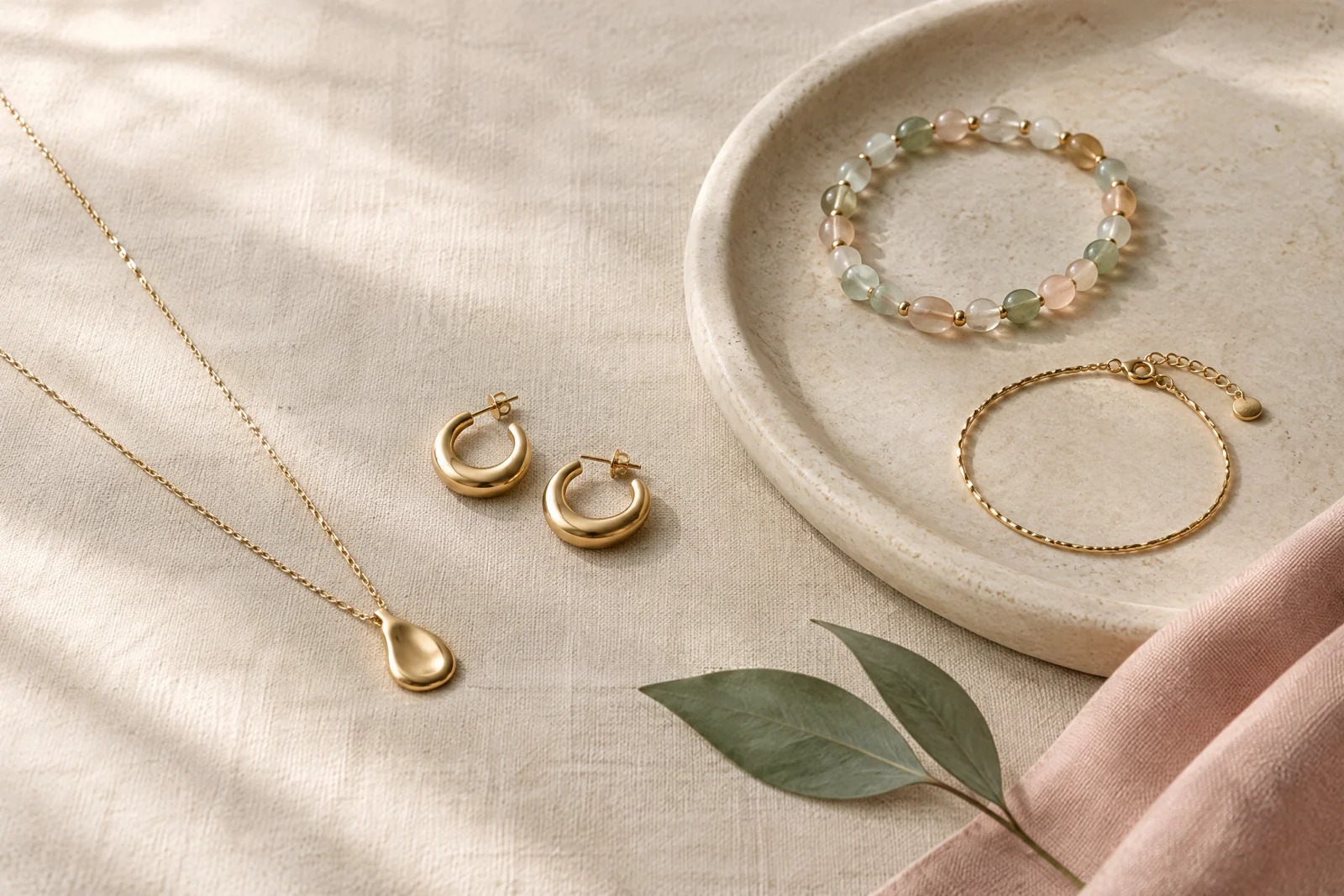
Rather than counting pieces, give your jewelry capsule wardrobe a few jobs. One role might be a quiet everyday choice that sits comfortably with your routine. Another can add definition near the face, while a third brings color or a motif when a simple outfit needs energy. Your jewelry capsule wardrobe can cover these roles with different types of pieces: a chain, a beaded necklace, earrings, a bracelet, or a ring. You do not need one of everything if you do not wear it.
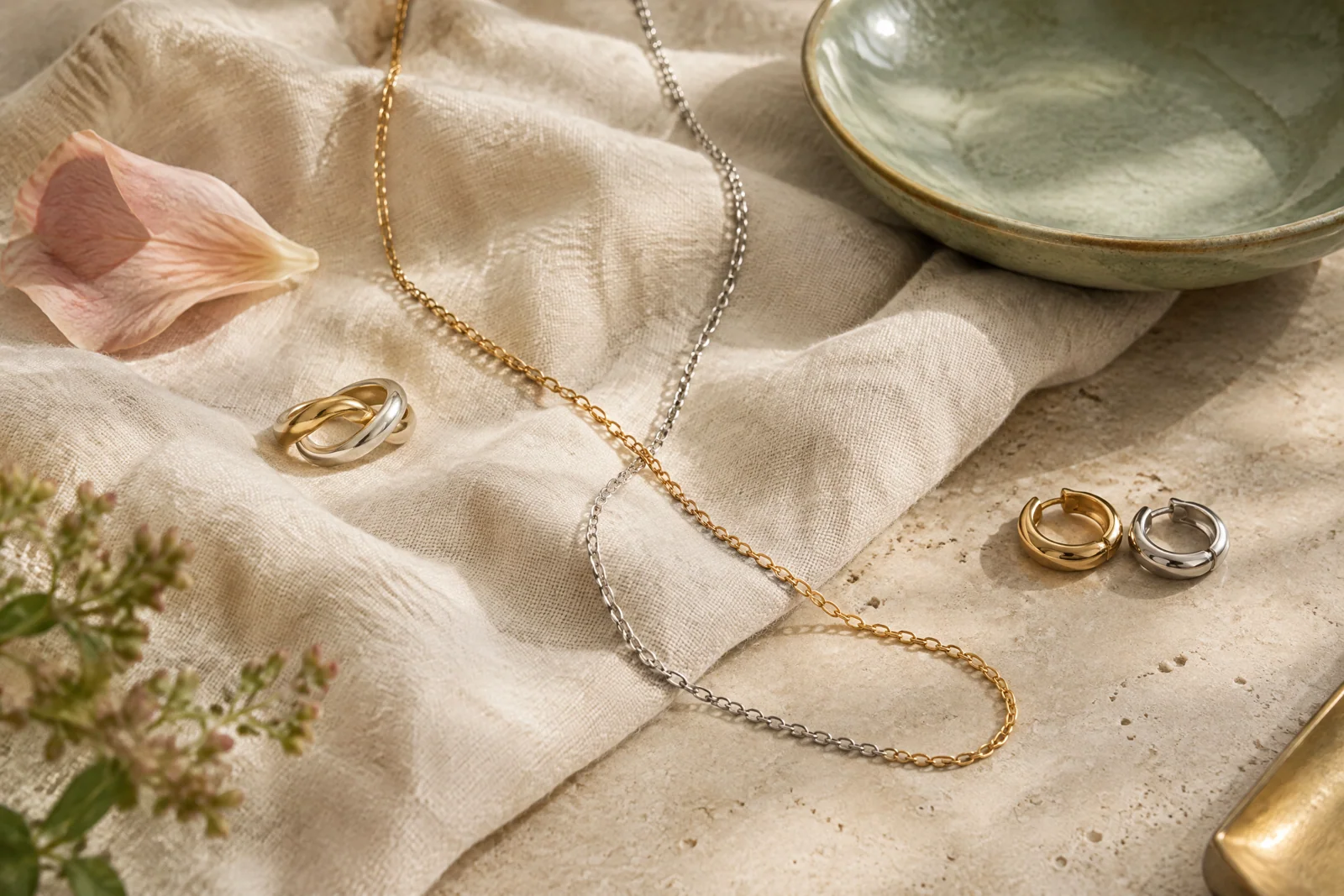
Color is a practical connector. Begin with the colors that already recur in your clothes—perhaps cream, navy, denim, black, warm brown, or sage—then decide whether you prefer jewelry that blends or contrasts. Gold-toned details can echo warm neutrals; silver-toned accents can feel crisp beside cool gray or blue. These are styling impressions, not rules: personal coloring, fabric, and light all change how a combination reads. A small accent in coral, red, green, or blue can act like punctuation against a neutral outfit.
Build a palette with a quiet base and one lively note
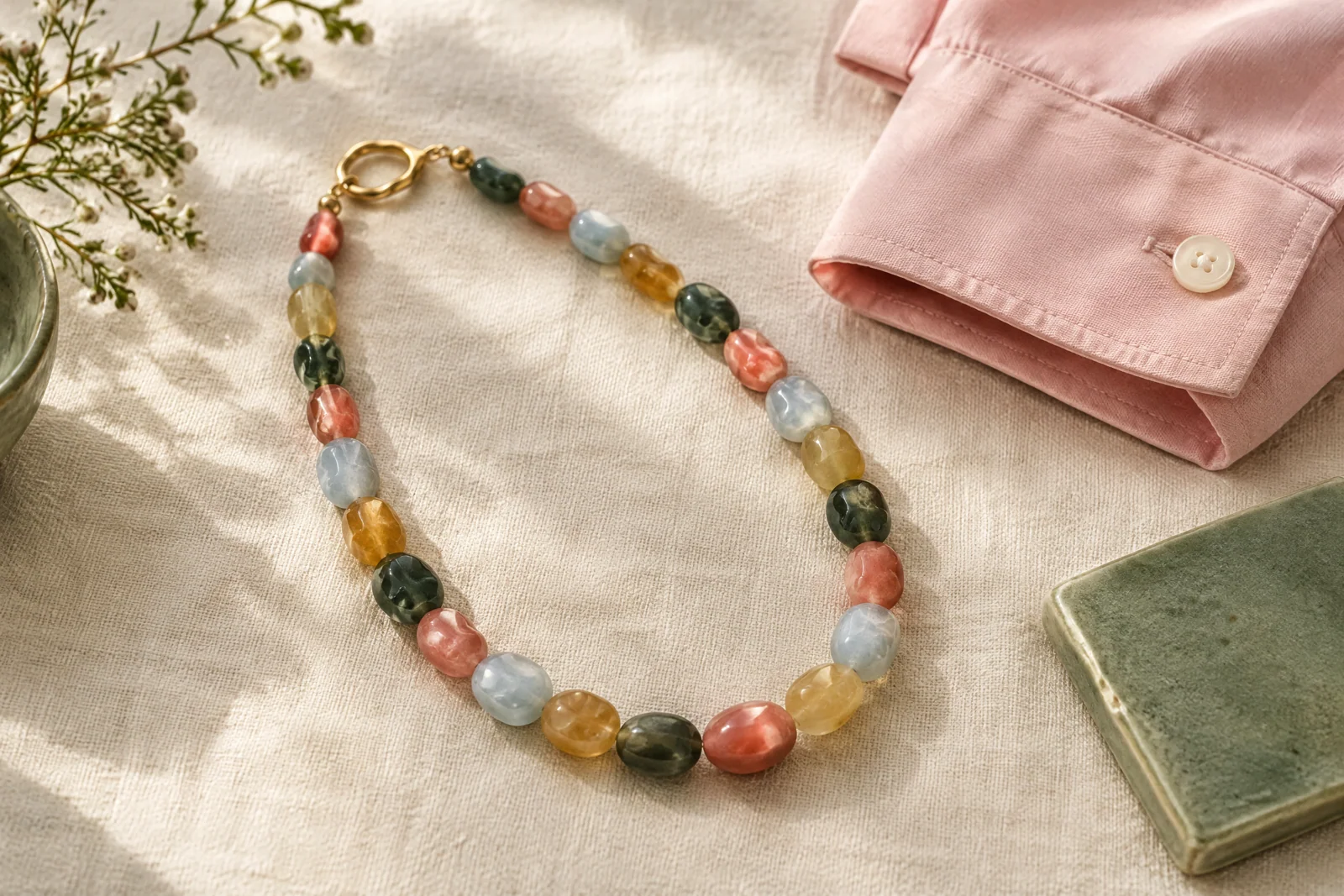
A useful formula for a jewelry capsule wardrobe is a calm base, a connecting metal tone, and one or two colors you genuinely enjoy wearing. The base might be clear, cream, or softly colored beads; the metal tone can repeat across a clasp, hoop, and chain; the accent can come from a saturated bead or playful charm. Repeating one color in two places—earrings and a bracelet, for instance—creates a considered impression without requiring a matched set. When you want a looser look, let the accent stand alone.
Use your closet to test whether a jewelry capsule wardrobe fits your real clothes. Lay a favorite necklace against three outfits you wear often. Does its length work with their necklines? Does the color disappear, harmonize, or provide the contrast you want? Try earrings beside the collars and scarves you reach for, too. For a jewelry capsule wardrobe that feels cohesive without looking uniform, combine a familiar shape with one unexpected detail. The bracelet collection can also offer a low-commitment color note when a necklace already has enough presence.
Balance everyday anchors with personality pieces
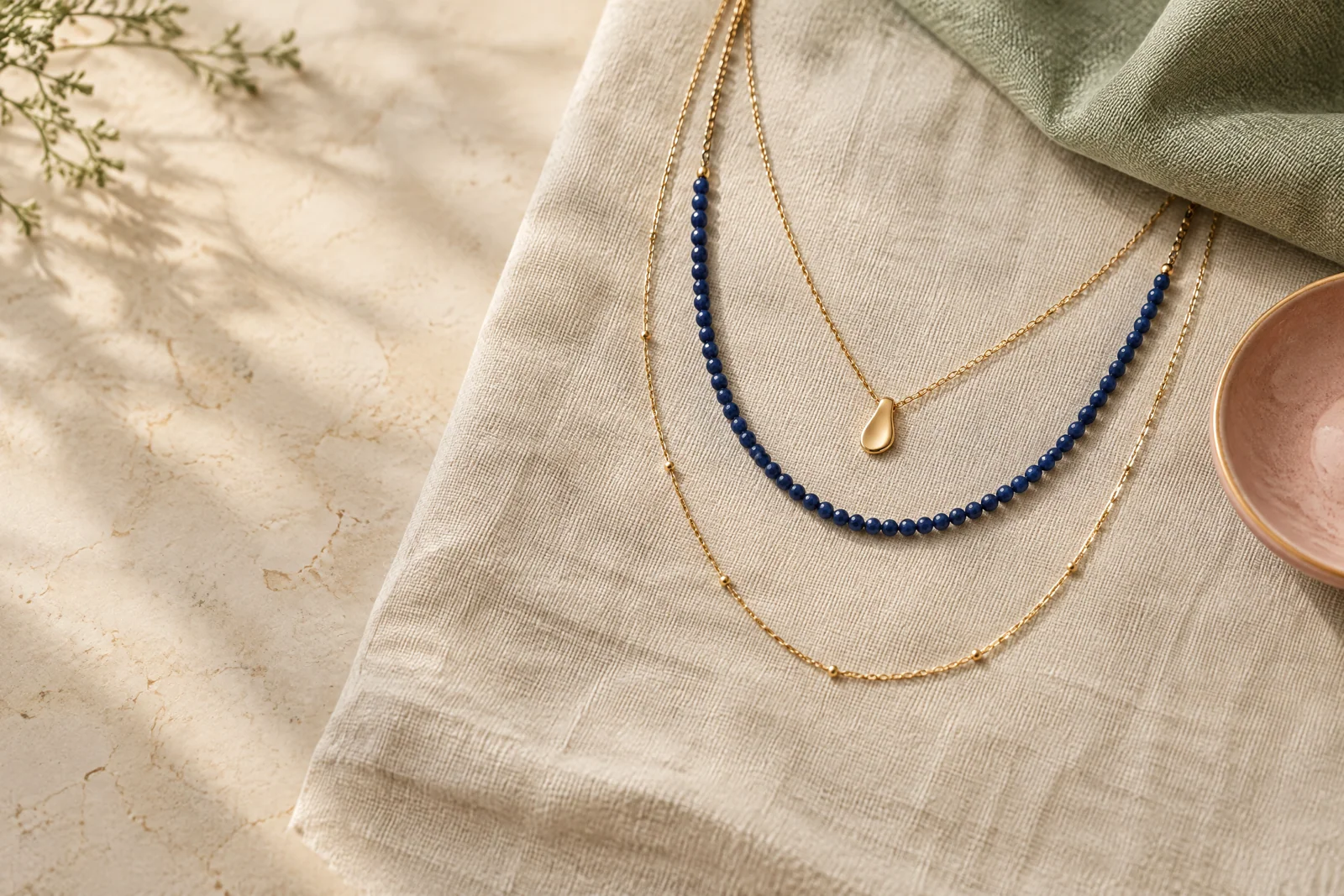
A jewelry capsule wardrobe becomes versatile when its pieces can shift between contexts. Think in pairs and combinations, not just individual items: a small pendant alone for a clean line, then alongside a short beaded strand; simple hoops with a patterned blouse, then a bolder earring with a plain top. If you like layers, vary necklace length and visual weight so the pieces remain distinct. Our guide to layering necklaces without the tangles explores ways to make those combinations feel intentional.
Product descriptions can help you picture proportions. The Mini Sun necklace is described as a small sun charm on a roughly 40 cm 14k gold-fill chain, with an 18k gold-plated stainless-steel charm; it is an example of a delicate anchor with a clear focal point. For a stronger color note, Karia is a 42 cm red glass-bead necklace with silver-plated mixed-metal details. These are illustrations of different styling roles, not a prescription to buy either piece. Material wording matters: gold-fill and gold plating describe different constructions, so keep the listing’s terms intact when comparing jewelry.
It can help to choose one “personality” piece that lifts the basics you already own. That might be a vivid strand, a sculptural earring, a symbolic charm, or a piece with a texture you love. The key is that it still feels like you. If it only works with one outfit you never wear, it may not earn a regular place in your jewelry capsule wardrobe. If it turns several familiar outfits into something you are excited to put on, its role is clear.
Try a one-week outfit test
To test a jewelry capsule wardrobe, set aside a small group and wear it through an ordinary week. Notice which pieces you choose on rushed mornings and which you save for a particular neckline or plan. A bracelet should not catch on sleeves you wear daily; a favorite earring should feel appropriate in the places you actually go. Try each candidate with at least three existing outfits. This quick test surfaces practical mismatches that a mirror-only try-on may miss.
For example, a green beaded necklace such as Jovie is described as a sage-green rondelle-bead necklace with a mix of gold-plated and 14k gold-fill details. Its soft color could sit quietly with cream or denim, while its bead texture gives a simple top more dimension. Whether a piece works for your capsule depends on the colors and proportions you wear—not on a claim that it is universally essential. A jewelry capsule wardrobe makes room for these personal discoveries, including the occasional piece that becomes a surprise favorite.
Keep the capsule wearable, cared for, and evolving
Once you have a working edit, make your jewelry capsule wardrobe easy to see. Separate necklaces so chains do not tangle, keep pairs of earrings together, and place the pieces you use most within easy reach. A small tray or divided box can be enough. Store jewelry away from damp areas and direct contact with cosmetics; wipe pieces gently with a soft, dry cloth when appropriate, and follow the specific care guidance for their materials. Mixed-material pieces may need more cautious handling, so avoid assuming every item can be soaked or cleaned the same way.
Notice gaps only after wearing the group for a while. Maybe you have plenty of necklaces but want an everyday pair of earrings; perhaps you own neutral pieces but miss a confident color. Write down the role you are missing before browsing. You can explore all collections with that purpose in mind, or compare the options in rings if a small hand detail would add something your outfits lack. Browsing with a specific gap in mind helps a jewelry capsule wardrobe stay focused and avoids buying another version of what you already wear.
Let real life decide what stays
Revisit your edit as your schedule, clothes, and preferences change. A piece that suited a season of open necklines may take a quieter turn under winter layers; a once-occasional color may become a favorite. Move things in and out without treating the capsule as a test you can fail. Keep sentimental pieces even if they are not part of the weekly rotation, and store them thoughtfully. The goal is not a tiny collection for its own sake, but a set of choices that feels inviting and easy to use.
Before adding anything, ask three questions: Can I name at least three outfits it will work with? Does it fill a role or color gap rather than duplicate a favorite? Will its size, fastening, and material suit the way I plan to wear and care for it? If the answers are clear, it may be a considered addition. If not, wait and see. A jewelry capsule wardrobe works best when it grows slowly from evidence—what you reach for, what makes you feel like yourself, and what fits your actual days.
Related reading
For more ways to make a small rotation go further, read How to Layer Necklaces Without the Tangles, explore color and texture in How to Style Beaded Necklaces with Everyday Outfits, and see how different finishes can share a look in A Practical Guide to Mixing Gold and Silver Jewelry.