The right necklace does not have to be complicated; it just needs to land in a place that feels considered with what you are wearing. Understanding necklace lengths helps you choose a chain that frames a neckline, balances a pendant, or adds a quiet finishing note instead of disappearing beneath a collar. A few centimeters can change the whole impression: a short chain feels close and polished, while a longer one draws the eye down and creates a different line. The best choice is personal, shaped by your proportions, the garment, and the day ahead. Here is a practical way to test the options before you commit.
Start with necklace lengths, then check where they fall
When comparing necklace lengths, you will see familiar labels such as collar, choker, princess, matinee, and opera. These names are useful shorthand, not guarantees about exactly where a piece will sit. A 16-inch chain is often called a choker or short necklace; an 18-inch chain is commonly described as princess length; around 20 to 24 inches often falls into the matinee range; and longer chains may be called opera length. These are general conventions for necklace lengths. Neck size, chain construction, pendant weight, and the shape of a neckline all affect the result, so treat the number as a starting point rather than a promise.
To picture how necklace lengths differ, imagine a chain following your body from the base of the neck. A short length may rest just above or around the collarbones. A middle length often meets the upper chest, and a longer one falls lower toward the center of the torso. A pendant can make a chain appear to sit lower because the drop begins at the chain's lowest point. Chunky beads or a broad clasp may also change how a necklace rests compared with a fine, flexible chain.
To choose necklace lengths with confidence, use a soft tape measure to check the circumference where you want the chain to lie. If you do not have one, place a piece of string around your neck at that point, mark where it meets, then measure the string against a ruler. For a pendant necklace, include the pendant's drop when estimating its final position. A trusted way to compare necklace lengths is to measure a necklace you already love: lay it flat, measure from clasp to the end of the chain, then compare its wearable loop against the one you are considering. Measurements listed by a shop may describe the full length, or the chain plus extender, so read the product details carefully.
Necklace lengths are easier to judge when you test them with the clothes you actually wear. A length that looks perfect over a crew-neck tee may vanish beneath a high collar, and a chain that sits neatly above a button placket may land awkwardly across a deep V. Stand naturally, relax your shoulders, and look at the necklace with the garment on. Avoid pulling the chain into place; the right fit should settle without constant adjusting.
Match the necklace to the neckline, not just the label
Think of necklace lengths as lines that either echo or gently contrast with the edge of a top. For necklace lengths with a crew neck, a short chain that sits above the fabric can define the open space near the throat. Alternatively, a longer pendant can fall over the shirt and create a vertical focal point. A very short necklace that rests exactly on a thick collar can feel crowded, so test whether a little breathing room above or below the edge looks more intentional.
Necklace lengths can follow the V-neck’s natural line toward the center of the chest. A pendant or chain that follows that shape can reinforce the line; a short, rounded necklace adds a softer counterpoint. Neither is a rule. If the neckline is deep, consider where the pendant ends in relation to the opening and whether you want it inside the V, above it, or resting over the garment. A square neckline often has a strong horizontal and vertical structure, so a simple chain or gently rounded pendant can soften it without competing with its geometry.
With a scoop neck, shorter necklace lengths can echo the arc, while a longer chain offers contrast and a lengthening line. Button-down shirts give you several styling choices: wear a short chain at the base of the throat with the top button open, place a medium pendant in the opening, or let a longer necklace sit over the shirt. Check that the clasp and pendant do not catch on buttons or feel trapped beneath the collar. With a high neck, the necklace usually needs to sit over the fabric to remain visible; a longer chain or statement pendant can make that placement feel deliberate.
Strapless and off-the-shoulder shapes leave more skin and fabric open, so a close-fitting necklace can bring attention to the collarbone, while a longer piece creates a relaxed vertical accent. If the top already has a ruffle, bow, prominent trim, or busy print, leave room for that detail. One useful styling test is to trace the neckline with your finger: choose a necklace that repeats its curve, points in a similar direction, or clearly stands apart. Necklace lengths work best when the relationship looks intentional rather than accidental.
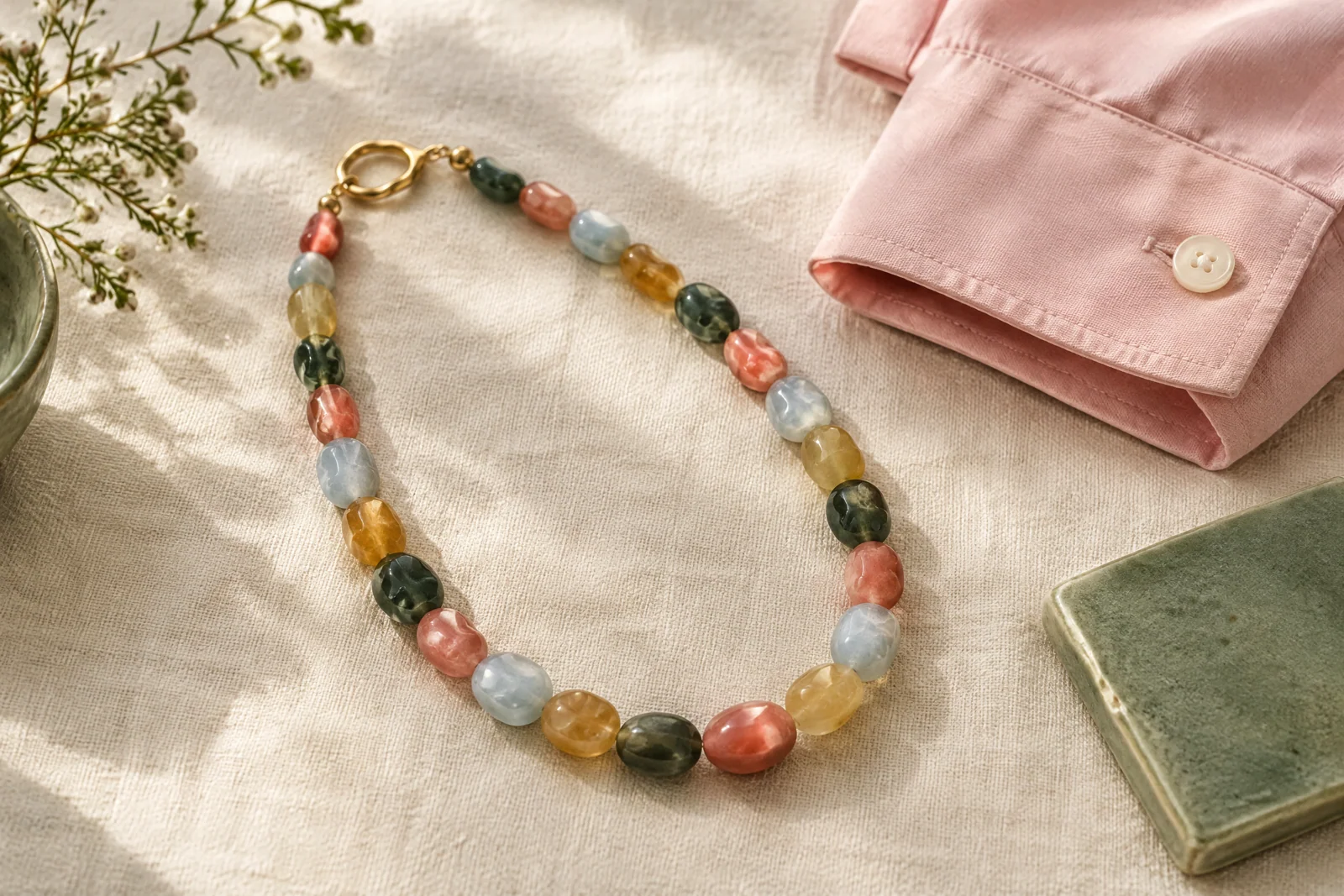
Color and visual weight matter, too. A fine chain can be lost against a textured knit, while a bead strand or pendant with a clear silhouette may show up better. Against a patterned top, a simpler shape often reads cleanly; against a plain neutral, color can provide the focal point. If you are exploring colorful pieces, browse the necklace collection for different shapes and tones, then compare their listed measurements with a top from your closet.
Choose a length that works with your proportions and plans
Necklace lengths can sit differently from person to person, so a size chart cannot replace a quick try-on. If you have a longer neck or a broader chest, a chain described as short may rest higher or lower than it does on someone else; a pendant can also shift as you move. Focus on the actual landing point you want rather than assuming a label will produce one universal look. When shopping online, compare the stated measurement with a necklace you own, and look for whether the measurement includes an extender.
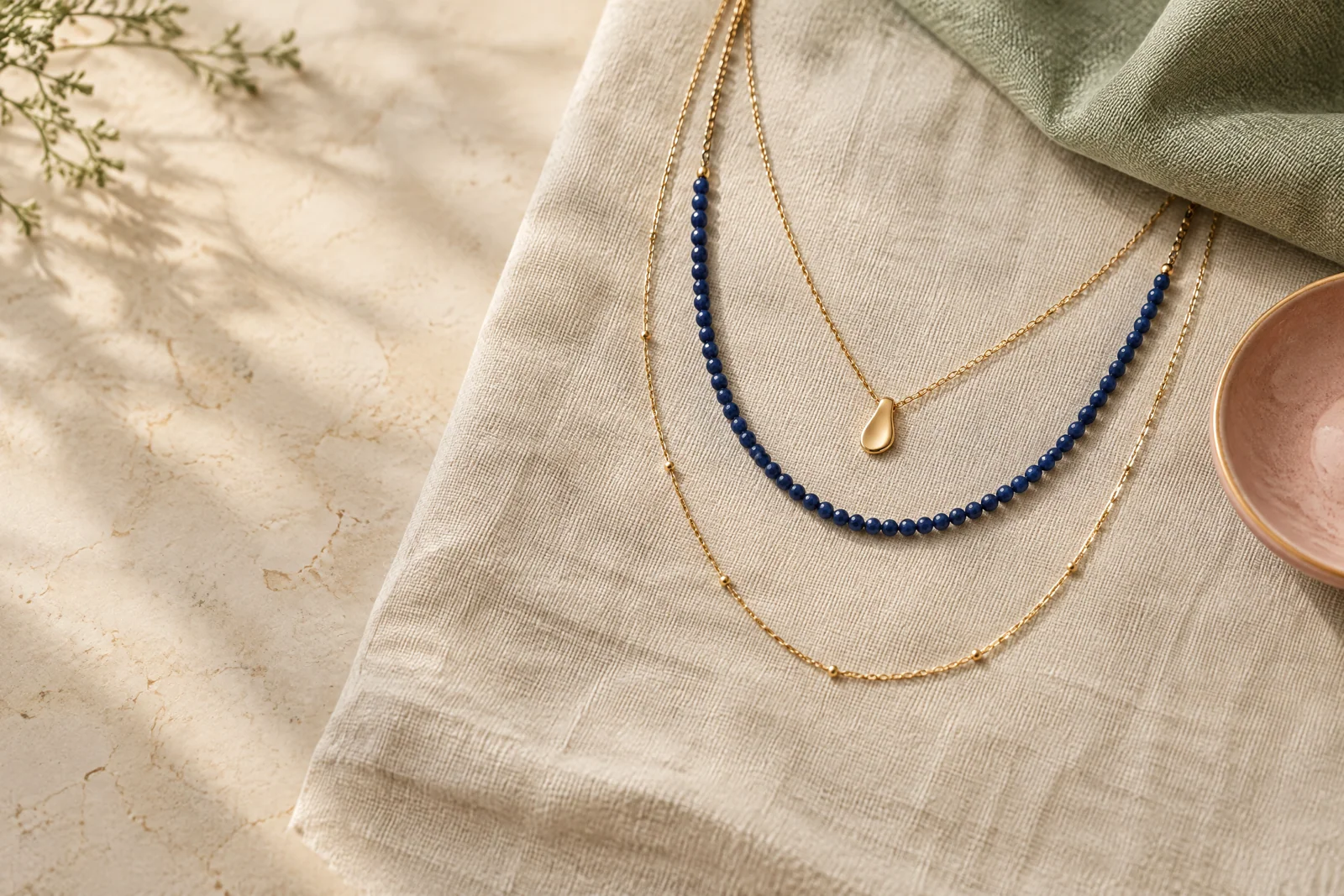
Extenders make necklace lengths more flexible, but they do not make every position possible. A short extender may shift the necklace just enough to clear a collar or separate two chains. Check the adjusted length on your body, especially if the piece has a pendant: adding length changes both the chain's position and where the pendant lands. Catalog descriptions show examples of this practical range. Duddingtons' Midnight glass-beaded necklace is listed at approximately 40 centimeters with a 5-centimeter extender, while its Mini Sun chain is listed at approximately 40 centimeters. Those measurements describe those specific pieces; they are not a fit guarantee for every wearer.
Layer with clear spacing and make the final fit yours
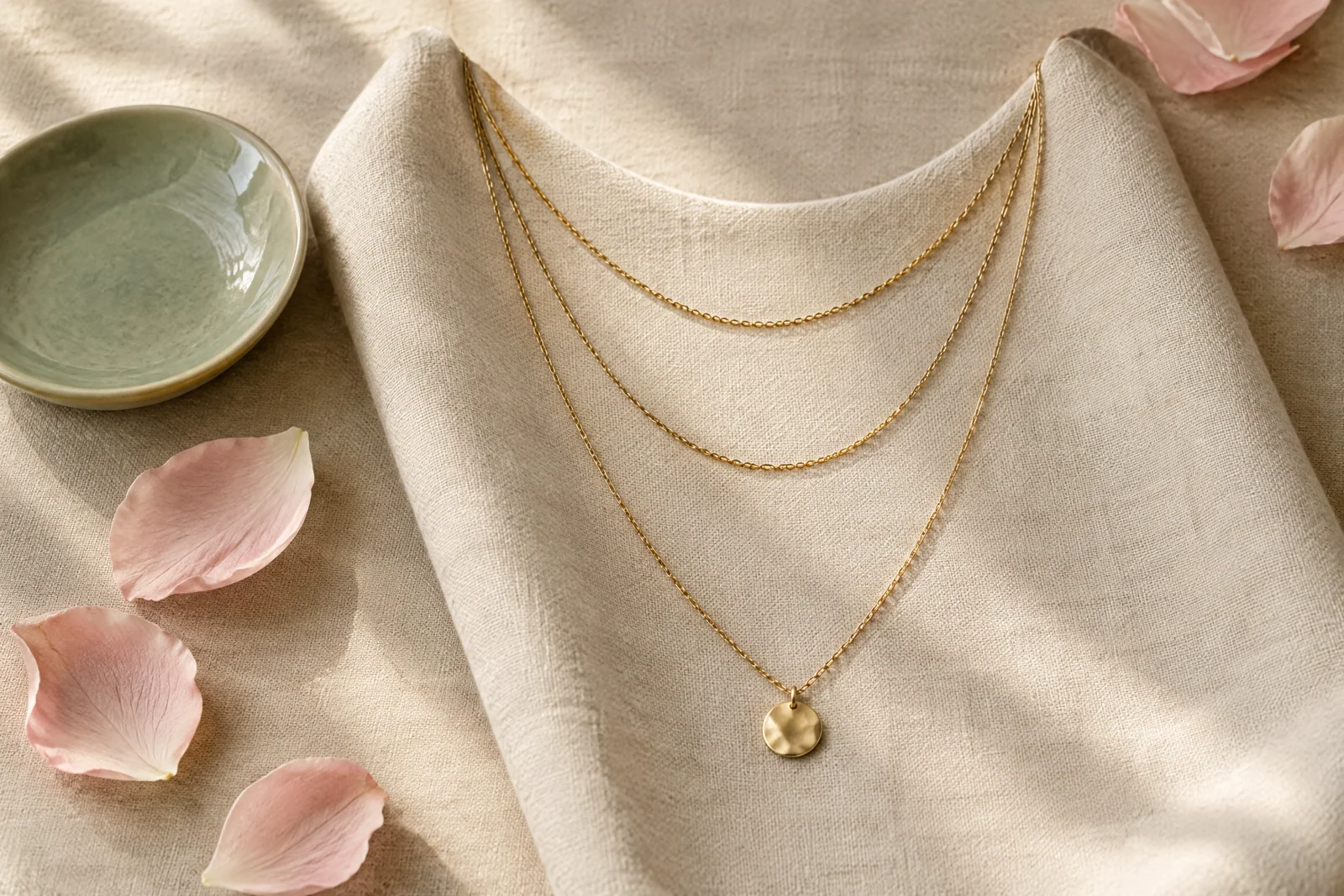
Layered necklace lengths feel most comfortable when each piece has a distinct place to land. Instead of choosing several chains with nearly identical lengths, create visible steps between them. A short chain can frame the base of the neck, a middle strand can sit near the collarbone or upper chest, and a longer pendant can provide the final vertical line. The precise intervals depend on each piece and your neckline; there is no required formula. What matters is that pendants and beads have room to be seen rather than collecting in one spot.
Varying texture and scale helps the eye separate the pieces. Pair a fine chain with a bead strand, or mix a small pendant with a more substantial plain chain. Keep one necklace as the focal point and let the others support it. Before putting them on, fasten each clasp and lay the pieces side by side to check that the lengths differ enough. Once worn, move your shoulders and gently shift the chains apart. If they repeatedly tangle or crowd one another, simplify the stack or change one length. For more ideas, see our guide to layering necklaces without tangles.
A reliable fitting routine is simple: measure the desired landing point, compare it with the garment, then try the necklace while moving naturally. Consider whether an extender offers a useful adjustment and whether the pendant adds extra drop. If the necklace is a gift or the exact fit is uncertain, a design with an adjustable chain can make styling more adaptable, as long as the product description confirms that feature. For a fixed-length piece, use the listed measurement and a string test instead of guessing from a photograph.
Most of all, treat necklace lengths as a styling tool, not a set of rules. Choose a close-fitting line when you want a neat accent near the collarbone, a middle length when you want an easy everyday focal point, or a longer drop when the outfit benefits from a vertical line. Then let your own comfort and taste have the final say. A small shift in placement can make a familiar top feel newly considered, and a necklace you can wear without fuss is usually the one you will enjoy most.
Related reading
For more thoughtful ways to wear your pieces, read How to Layer Necklaces Without the Tangles, How to Style Beaded Necklaces with Everyday Outfits, and A Practical Guide to Mixing Gold and Silver Jewelry.