Bracelet stacking should feel like a small pleasure, not a wristful of clinking distractions. The best bracelet stacking starts with comfort: pieces that sit securely, move easily, and suit the way you use your hands. Once fit is right, you can play with contrast—fine chain beside rounded beads, a quiet neutral beside a favorite color, or one sculptural clasp among slimmer shapes. There is no ideal number to reach. One bracelet can be a stack; three can feel effortless when each has room to be itself. Think of bracelet stacking as editing, not adding for its own sake.
Think of your wrist as a narrow frame rather than a blank space to fill. A little breathing room lets the pieces catch light and keeps them from crowding a cuff or catching on a sleeve. This guide walks through fit, proportion, color, and practical wear so you can build a combination that looks considered and still feels like you. For a broader look at options, browse the bracelet collection and use your own favorites as the starting point.
Start with fit, movement, and the way you wear your hands
Comfort is personal, but a useful first test is simple: can you bend your wrist, type, carry a bag, and reach for a cup without the pieces pressing into your hand or sliding over it? Bracelet stacking works best when the jewelry has some movement but does not travel so far that it bumps repeatedly against your hand. In practical bracelet stacking, ease matters as much as appearance. Try a new arrangement for a few minutes at home before wearing it through a full day. Notice the fit while your arm is relaxed and again when your wrist bends.
Measure the wrist where you naturally wear a bracelet, then compare that measurement with the piece's stated length when available. A close fit may suit a light chain or cord, while a bead strand often needs a little extra ease so it does not feel tight when the wrist flexes. A clasp, toggle, or extender also affects how a bracelet sits. If you are between sizes or uncertain about a style's movement, contact the shop before relying on a guess; a measurement listed in a product description is more useful than assuming all bracelets fit alike.
Consider your day, too. A close-fitting, smooth bracelet is usually less likely to snag on a knitted cuff than a piece with prominent links or a projecting charm. If you spend hours at a keyboard, keep bulky elements away from the point where your wrist rests on the desk. For hands-on work, sport, bathing, or sleep, take jewelry off rather than testing it against friction, sweat, water, or pressure. These are practical precautions, not claims that any particular material is indestructible.
A good comfort check for bracelet stacking is the “one-piece first” method: wear one bracelet for a while, then add a second and see whether the pair still moves naturally. If a clasp catches another bracelet every time you rotate your wrist, change the order or choose a smoother neighbor. Comfortable bracelet stacking is not a challenge to wear the most at once; thoughtful bracelet stacking leaves room for movement, giving each piece an easy, unforced place in the conversation.
Build contrast with scale, texture, and a little breathing room
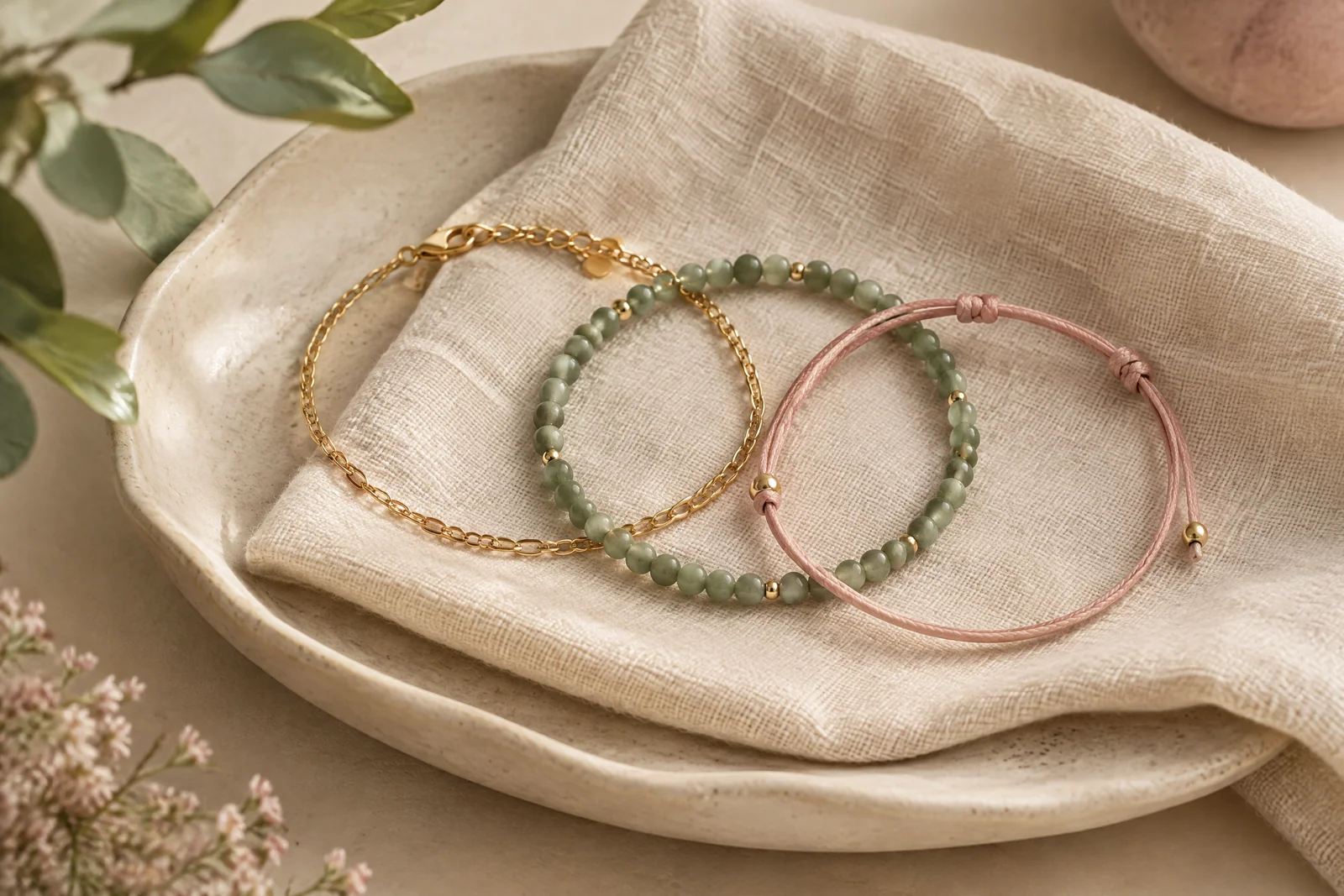
Stacks feel intentional when their shapes vary without competing. Pair one fine chain with a round-bead strand, or let a substantial link bracelet stand beside a narrow cord. Similar widths can work, but if every piece is equally bold, the group may read as one dense band. If every piece is delicate, a single broader shape can give the eye a place to pause. Bracelet stacking benefits from a clear lead piece and quieter supporting pieces. This makes bracelet stacking feel composed rather than crowded.
Try placing the heaviest-feeling bracelet closest to the hand and lighter pieces above it, then reverse the order. Neither arrangement is a rule: the better choice is the one that settles comfortably and looks balanced on your wrist. A clasp can be a design detail, so turn it where it is easy to reach and where it does not rub against another focal point. If a bracelet has an oversized clasp or larger beads, give it a little space instead of wedging it tightly between neighboring pieces.
For an example of a simple anchor, the Sunrise bracelet is described in the catalog as a chunky flat cable chain with an oversized spring-ring clasp, gold-plated mixed metal, and 14k gold-fill details. Its approximate 18.5 cm measurement makes checking your own wrist especially sensible. A substantial chain like this can be worn alone, or balanced with a slim, smooth cord rather than another equally chunky chain. That is an outfit idea, not a claim about how it will fit every wearer.
Try the “two textures and one pause” formula: choose two tactile contrasts, then leave a little visible wrist between them or add a very simple piece as a bridge. For instance, a rounded bead beside a flatter chain creates contrast; a plain narrow bangle or cord can soften the transition. When bracelets overlap constantly, sound loud, or pull hair and fabric, remove one. The lighter edit often makes the remaining pieces more noticeable. That is a useful bracelet stacking principle whenever a detail keeps catching your eye.
When comparing options, look through the bracelet collection for differences in link size, bead scale, and closure style rather than treating every gold-tone piece as interchangeable. You can also pair a bracelet with a restrained necklace from necklaces or keep the wrist as the only focal area. One intentional point of emphasis usually feels more relaxed than a stack that competes with every other accessory.
Use color as a thread, not a matching test
Color is an easy way to make different shapes feel connected. In bracelet stacking, one repeated hue can do more than perfect matching. Start with one color already in your clothing—a warm brown, soft blue, leaf green, or a muted pink—and repeat it in just one bracelet. Then let metal tone, bead texture, or a neutral cord do the connecting work. Bracelet stacking does not require every piece to match, and exact color matching can make a combination feel more formal than the rest of an outfit.
Warm colors such as rust, coral, and honey sit naturally beside cream, tan, denim, and earthy green. Cooler blues and lilacs can sharpen a white shirt or balance charcoal and navy. Sage and other softened greens are especially adaptable because they read like color while behaving almost like a neutral. If a bright accent feels too assertive, let it be the only saturated element on the wrist and keep the surrounding pieces simple.
For a little color with a defined focal point, the Missy bracelet is described as an amethyst-bead design with unique markings, a textured gold-plated toggle, gold-plated metal, and 14k gold-fill details; the catalog gives an approximate length of 18 cm and 12 mm beads. Its purple beads can be the one expressive note beside a quieter chain or neutral sleeve. Since the stones have individual markings, expect visual variation rather than identical beads. Use the product description to understand materials, and do not assume a color photograph will look exactly the same on every screen.
Metal tone can also bridge a colorful stack. Gold-tone details warm blush, amber, and olive; silver-tone details can make icy blue, lavender, and crisp white feel especially fresh. Mixing gold and silver is welcome if it looks deliberate: repeat both tones at least once, or let one be the clear lead and use the other sparingly. The aim is a visual rhythm, not a strict color rule. Bracelet stacking can be a gentle mix of tones when one color clearly leads. If you enjoy more than one palette, explore accessories for other ways to echo a hue without adding another bracelet.
Before getting dressed, lay the pieces beside your sleeve or hold them against the fabric. A stack that looks lovely against bare skin may disappear under a dark knit or tangle with a loose cuff. A short sleeve gives more room for layered color; a narrow cuff may call for one low-profile bracelet. In bracelet stacking, clothing is part of the composition—and the best color choice is the one you will want to wear again.
Make a stack easy to wear, remove, and care for
Keep the routine uncomplicated. Good bracelet stacking is easy to put on and take off. Fasten each bracelet separately, check that clasps have closed, and make sure a toggle or extender is not sitting where it presses into your wrist. If you are combining several pieces, put them on one at a time instead of fastening a cluster all at once. This makes it easier to notice a snagging link, a twisted cord, or an uncomfortable fit before you head out.
Care depends on materials, so avoid treating a mixed-material stack as though every piece can be cleaned the same way. Remove bracelets before applying lotion or fragrance, and take them off before swimming, showering, exercise, or sleep as a cautious everyday habit. After wear, wipe a piece gently with a soft, dry cloth if its materials allow; follow the specific care guidance for stones, plated surfaces, cord, or other components. Do not soak a mixed-material bracelet or use an ultrasonic cleaner unless its maker explicitly says that is suitable for every component.
Store pieces separately when possible. A small pouch or divided compartment reduces tangling and keeps a clasp from rubbing against beads or a more delicate finish. Lay cords without sharp bends, and avoid pulling a snag free by force. If you notice a loose connection or damaged clasp, stop wearing the piece until it can be checked. A little attention between wears helps keep bracelet stacking enjoyable rather than turning the jewelry box into a knot of chains.
For work, travel, or a long day, edit for the setting instead of trying to make one stack do everything. A single close-fitting bracelet may be the comfortable choice at a desk; a bolder combination might suit dinner when sleeves and movement are different. Keep a favorite pairing together in a pouch so you can recreate it, but store each bracelet separately inside. Small routines—testing fit, checking closures, and removing pieces when conditions are rough—make personal style easier to repeat.
Most of all, let comfort set the limit. If the bracelets tap constantly, restrict movement, or distract you, take one off and see how the look changes. A stack can be two pieces, three pieces, or a single bracelet worn with intention. The most successful bracelet stacking is the one that still feels natural an hour later. Comfortable bracelet stacking should work with the day ahead, not against it, bringing a bit of color or texture into an outfit without asking for attention all day.
Related reading
Continue exploring personal styling with How to Layer Necklaces Without the Tangles, How to Style Beaded Necklaces with Everyday Outfits, and A Practical Guide to Mixing Gold and Silver Jewelry.