Duddingtons jewelry is easiest to understand not as a uniform look, but as an invitation to wear color and personality in ways that feel natural to you. Think of the pieces as small, expressive decisions: a warm bead against a crisp shirt, a playful charm with a simple knit, or a familiar pair of earrings that makes an ordinary outfit feel considered. The aim of this guide is to explain that point of view and offer useful ways to make it your own.
Duddingtons jewelry draws on a family surname and a playful, personal point of view. Its catalog brings together varied colors, silhouettes, and material descriptions, so no single formula defines the collection. Here, “everyday” does not mean plain or interchangeable. It means choosing jewelry that works with the clothes, colors, and rhythms you already enjoy, then reaching for it again because it feels like you.
Color comes first, but it does not have to be loud
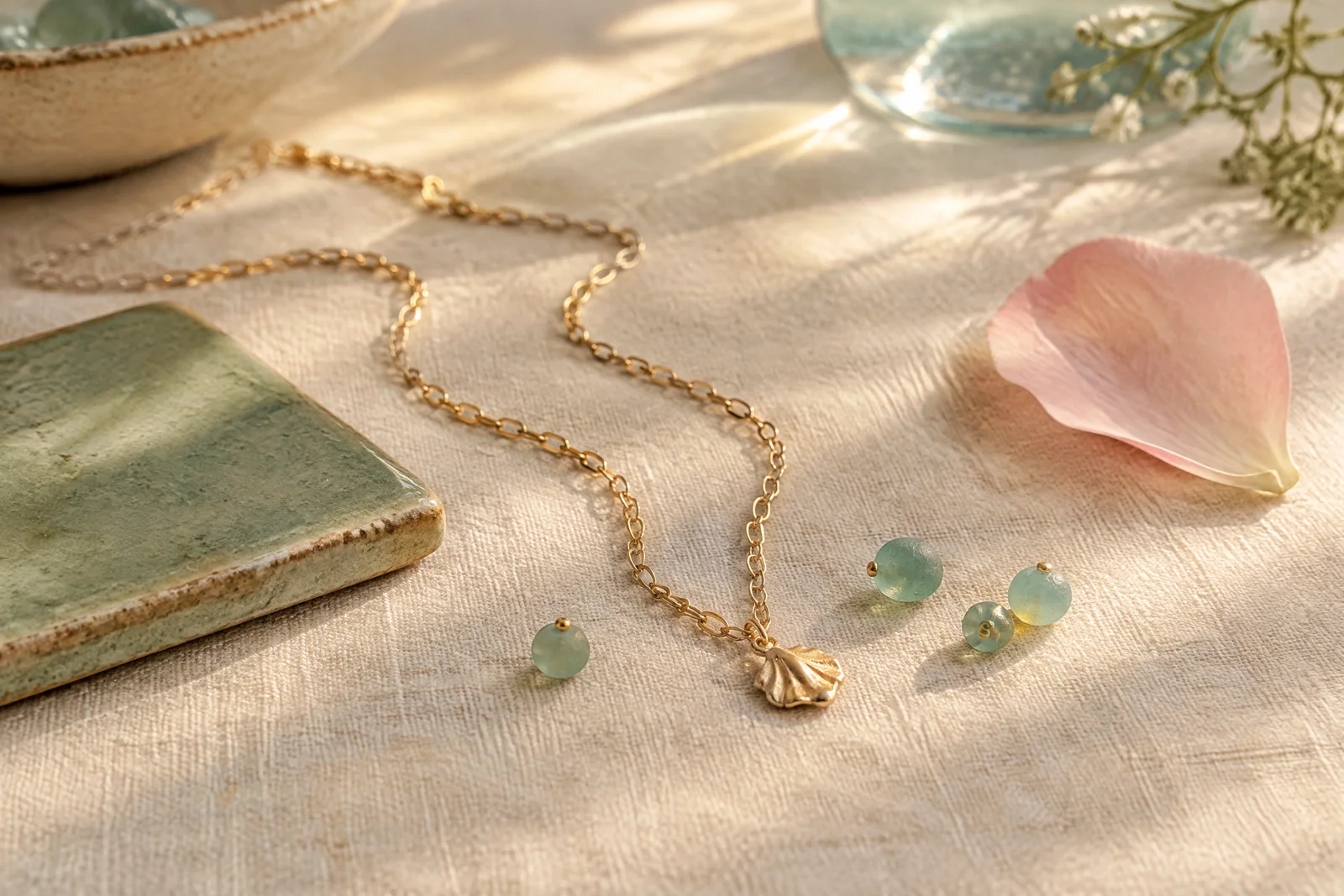
Color is often the quickest way to make a piece feel personal. Duddingtons jewelry includes both quiet hues and stronger accents, and the difference between them is not a question of right or wrong. A muted green can read as a soft neutral; coral or red can become the one vivid note in an otherwise calm outfit. Start with the effect you want rather than a rule about which shades are “supposed” to go together. This makes Duddingtons jewelry easier to approach whether you prefer soft color or a clear pop.
For an easy first experiment, look at the colors already in your closet. Cream, denim, navy, black, and soft gray all give a colored necklace room to register. If you wear a lot of warm neutrals, coral, tomato red, or gold-toned details can echo that warmth. If your daily palette is cooler, sage, blue, or silver accents may feel at home. These are invitations, not strict color theory: personal preference and the light in which you wear an outfit matter more than a chart. Use that personal palette as your guide to Duddingtons jewelry.
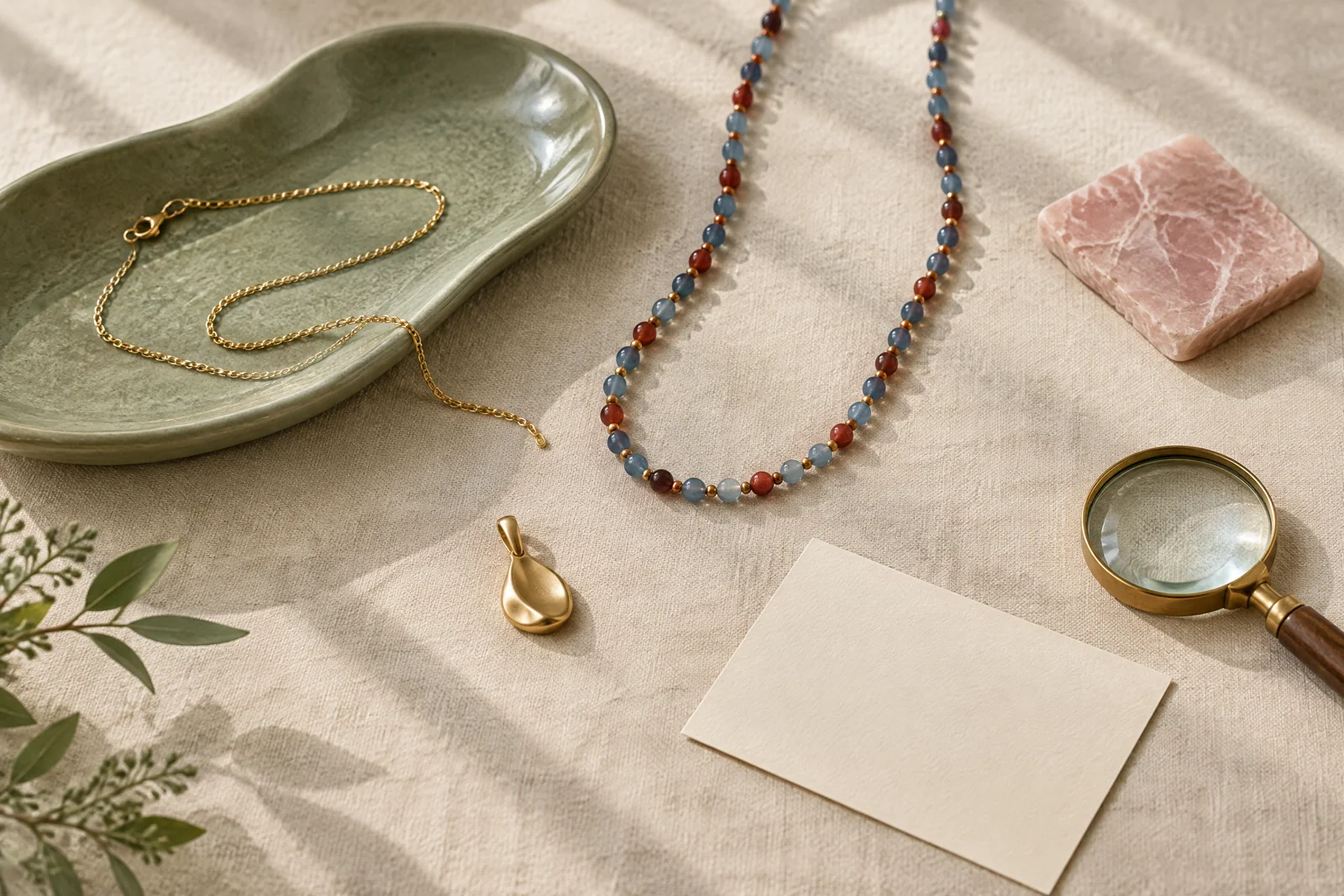
Then decide whether you want harmony or contrast. For harmony, repeat one shade in two places—a green bead with a sage scarf, for instance—or choose a piece whose color sits close to your clothing. For contrast, let one small accessory carry the brighter color while everything else stays simple. A red bead against a pale shirt reads differently from red beside a patterned blouse; both can work, but the quieter background makes the accent clearer. This is a simple way to let Duddingtons jewelry add color without making the whole outfit feel busy.
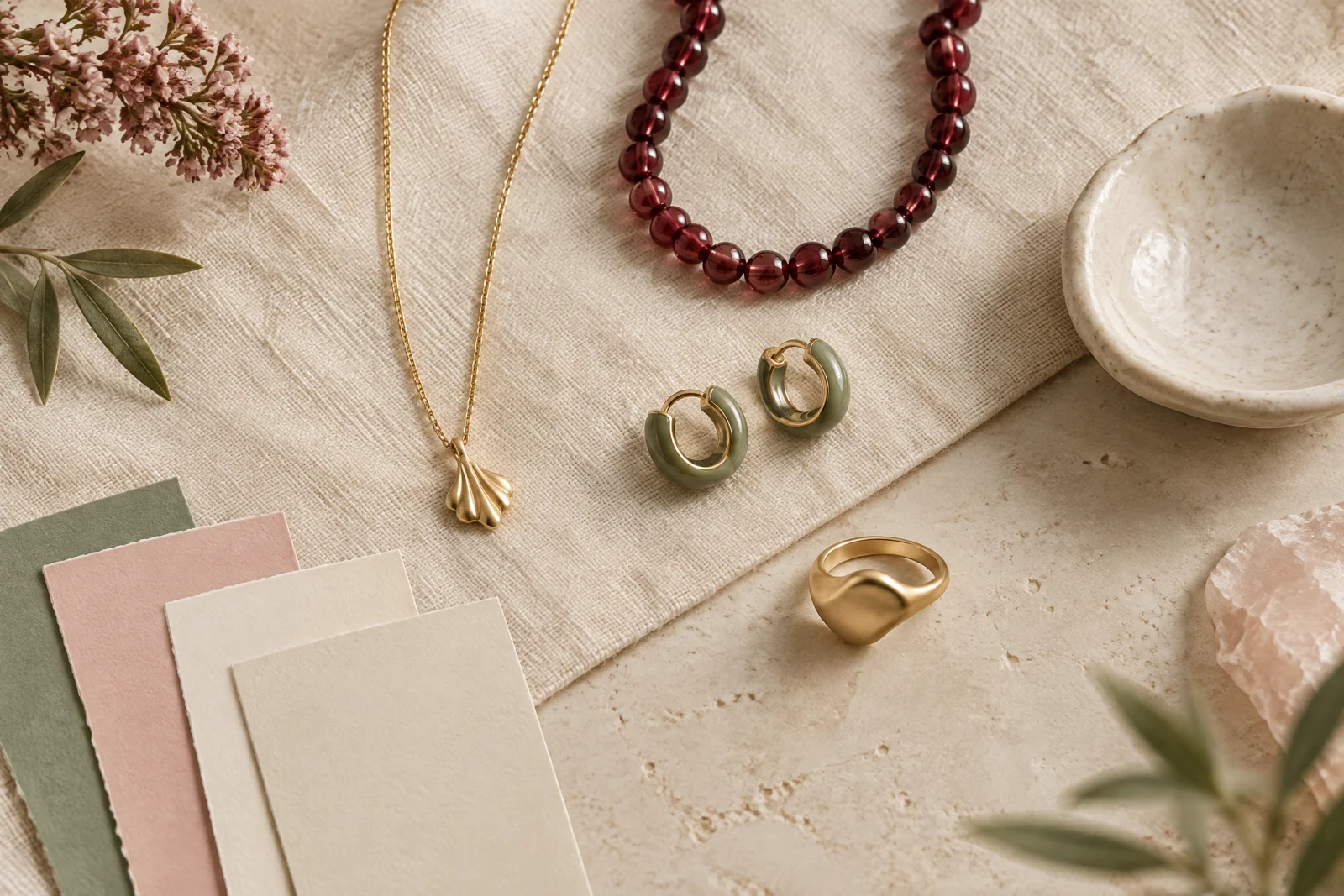
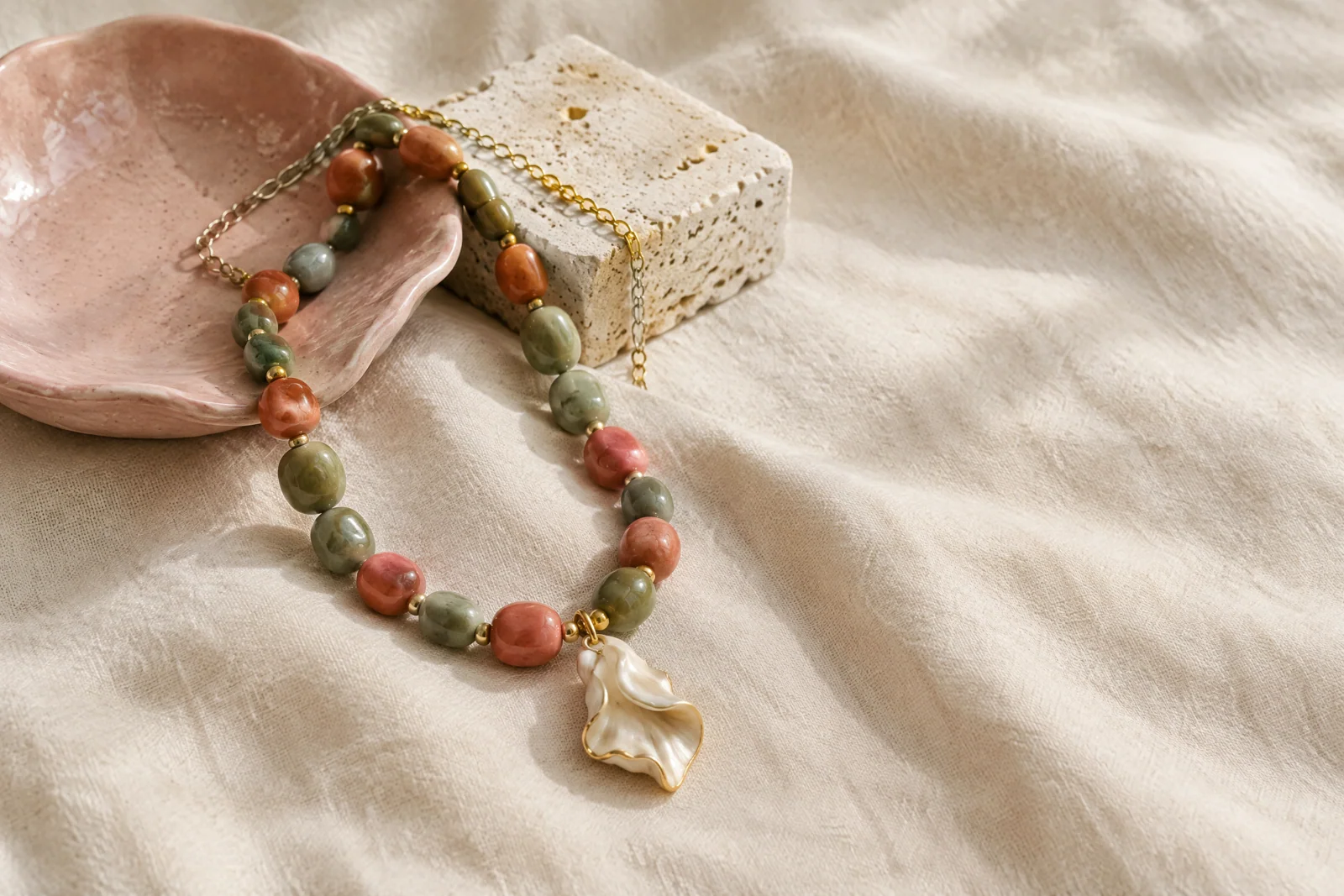
Catalog examples show how different a single color can feel in different materials. Karia is described as a rich red glass-bead necklace, with silver-plated mixed-metal details, 10 mm beads, and an overall length of 42 cm. That combination suggests a crisp color accent with cool-toned punctuation. Fenella, by contrast, uses coral-colored acetate beads and gold-plated mixed-metal details; its approximate 42 cm length plus an extender gives it another proportion and a warmer finish. These descriptions are useful starting points for comparing color, scale, and materials—not a promise that either piece will suit every wardrobe or occasion. Seeing Duddingtons jewelry through color, scale, and finish helps make comparisons more specific.
When a color feels unfamiliar, test it in a small dose. Wear one colored necklace with a solid top before pairing it with prints, or echo its shade in a bag, belt, or lipstick if that is already part of your routine. A full tonal outfit is not required. The most convincing styling often leaves the jewelry as the only unexpected detail, which lets the color feel deliberate rather than demanding. That restrained approach is one useful way to wear Duddingtons jewelry in a familiar wardrobe.
Character lives in the details
Color catches the eye, but shape and finish give a piece its character. A rounded bead feels different from a flat charm; a small-scale necklace reads differently from a sculptural pendant. Duddingtons jewelry can be playful, polished, relaxed, or graphic depending on those choices. Instead of asking whether a piece is “dressy” or “casual,” ask what its details contribute to the outfit you have in mind. In Duddingtons jewelry, those small choices are often what give a look its individual character.
Proportion is a practical place to begin. If a necklace has substantial beads, let it have visual space: a plain crewneck, open collar, or simple dress can make the shape easy to see. Fine chains and modest charms can sit comfortably alongside texture or a pattern because they take up less visual room. With earrings, consider both their length and the outline of your neckline. A clean neckline gives a statement shape space, while a detailed collar may call for a smaller earring or no necklace at all. Paying attention to proportion makes Duddingtons jewelry feel considered rather than crowded.
Mixing finishes can help an outfit feel collected rather than overly matched. If a piece uses a silver-toned finding, it does not mean every other accessory has to be silver. Repeating one element—perhaps a metal tone, a bead color, or a rounded shape—can connect pieces without making them identical. For a more measured start, wear one metal near the face and another on a wrist or hand, then see whether the overall balance feels intentional. There is no need to buy a complete matching set to make the look cohere. This mix-and-repeat approach keeps Duddingtons jewelry personal instead of overly coordinated.
Material descriptions are part of the character, too. A piece made with glass beads will not have the same feel or construction as one using acetate, shell, faux pearls, or a plated metal component. Read the product description closely and use its exact language: gold-plated and gold-filled are not interchangeable terms, and a listed metal detail does not automatically describe every component. If you are unsure about a component, length, closure, or how a piece will sit, check the product information or ask before deciding. That small pause helps you choose for both appearance and expectations.
The collection is not a styling mandate. If your natural preference is a single, fine chain, a confident bead necklace can still work as a one-piece focal point; if you like a layered look, keep the shapes and lengths distinct enough to read separately. Character can come from one unusual silhouette or a single bright bead as much as from a dramatic statement. That flexibility is what makes Duddingtons jewelry feel approachable: personality is a starting point, not a dress code. The best expression of Duddingtons jewelry is the one that fits your own taste.
Everyday style is about repeat wear
“Everyday” is less about a piece being visually quiet than about knowing how it fits into your real routine. Consider where you spend your time, what necklines and sleeves you wear most, and how much jewelry feels comfortable through a full day. A necklace can be beautiful in a product image and still not be the one you reach for if its length does not suit your usual collars. Think through those details before you choose, especially when shopping online. Practical fit is central to making Duddingtons jewelry part of a real routine.
Try a simple three-part check: first, name the outfits you would pair with it; second, note whether its color and scale suit those clothes; third, consider how you will store and care for it. If you can picture several existing outfits rather than one special occasion, that is a helpful sign the piece may earn repeat wear. This is not a formula for predicting your future style. It is a way to focus on your own habits instead of buying for an imagined version of your calendar. This habit can make a choice of Duddingtons jewelry feel more considered and less impulsive.
Small styling adjustments can shift the mood without changing the jewelry. A colored necklace over a white tee feels easy; with a blazer or a dress, the same piece may look more composed. A pendant at the neckline draws attention upward, while a longer strand can create a different line over a top. Try the piece with clothes you already own and check it in a mirror from a few feet away, not only close up. That wider view helps you judge whether the jewelry balances the whole outfit. It is a useful final check when styling Duddingtons jewelry.
Comfort and care matter to repeat wear, but care should follow the materials listed for that particular item. As a cautious habit, put jewelry on after applying fragrance, lotion, or hair products, and take it off before activities that could snag, knock, or expose it to water or chemicals. After wearing, use a soft dry cloth when appropriate and store pieces separately so chains and surfaces are less likely to rub or tangle. For mixed-material jewelry, avoid blanket soaking or a one-size-fits-all cleaning method; when in doubt, follow the product guidance or ask the retailer. Thoughtful care helps keep Duddingtons jewelry ready for the next outfit.
Build a small rotation around what you genuinely wear: perhaps one color-forward necklace, a pair of earrings that works with multiple necklines, and a bracelet or ring that does not compete with your daily tasks. A few distinct favorites can offer more variety than several pieces that all serve the same role. If you like changing things up, let the outfit lead: choose a focal piece first, then add only what improves the balance. This is a low-pressure way to make Duddingtons jewelry earn a place in rotation. For more ideas, browse the necklace collection, earrings, and bracelets by category.
Explore the collection with your own point of view
Browsing a broad assortment can feel easier when you set a simple intention. Are you looking for color, a particular silhouette, a gift, or a piece that fills a gap in your routine? Use collection filters and product descriptions to narrow the field, then compare scale, materials, and length rather than relying on a photograph alone. Color can shift with screens and lighting, so treat the written description and any measurements as useful companions to the image.
Let curiosity guide you, but take practical questions seriously. Check what materials are named, whether dimensions or an extender are specified, and whether the design is likely to sit where you want it. If a detail is missing or unclear, contacting the shop is better than assuming. Duddingtons lists contact information at 77 San Marco Ave, St. Augustine, FL 32084, by email at [email protected], and by phone at +1 904 481 8815. Confirm any current details directly before making plans; this article does not make claims about hours, shipping, returns, or availability.
For a closer look at the brand’s point of view, visit the about page and explore all collections. You might begin with a calm base and one colorful detail, or follow a shape you already love into a new material. There is no single signature uniform to master. The useful question is simply which piece feels like a natural extension of your own wardrobe—and whether you can imagine wearing it again next week.
That is the most practical way to think about Duddingtons jewelry: an assortment that invites individual styling, where color is available in different moods and character comes through in proportion, material, and detail. Choose with your actual outfits and habits in mind. Let a favorite be distinctive without requiring the rest of your look to compete. Everyday style can be personal and expressive at once. In that sense, Duddingtons jewelry does not need a special occasion.
Related reading
For a local perspective, read A Jewelry-Inspired Weekend Style Guide to St. Augustine. If you are comparing options from home, continue with How to Shop a Jewelry Collection Online with Confidence. Boutique buyers may also enjoy Curating Jewelry for a Boutique: A Wholesale Planning Guide.