Freshwater pearls and faux pearls can both bring soft luster to an outfit, but they are made differently and wear differently. Knowing what the words mean makes it easier to choose the look, feel, and care routine you actually want. In this guide to faux pearls, we’ll separate cultured pearls from imitation styles, explain what to look for in a description, and share practical ways to wear and care for each. Neither choice is automatically the “right” one: the best piece is the one whose materials and character suit your priorities. For faux pearls, knowing the stated finish is part of making that choice.
What the terms mean: cultured, freshwater, and faux
A freshwater pearl is a real pearl grown inside a freshwater mollusk with human involvement. That makes it a cultured pearl, not an imitation. As the Gemological Institute of America (GIA) explains in its overview of pearl types, cultured pearls develop when a mollusk secretes nacre during a process initiated with human assistance. “Freshwater” describes the environment and type of pearl production; “cultured” explains how its growth began. It does not mean the pearl is fake or lab-made from plastic.
Faux pearls, also called imitation or simulated pearls, are manufactured objects designed to resemble pearls. Their cores and finishes vary: a maker might use glass, plastic, or another material with a pearly coating. “Faux” tells you the item is not a pearl formed in a mollusk; by itself, it does not identify the base material, coating, or expected longevity. For faux pearls, those construction details are worth checking rather than guessing. Those details require a more specific product description.
Natural pearls are a third category. They form without human intervention and are distinct from cultured pearls, even though both are genuine pearls. In everyday jewelry shopping, you will often encounter cultured rather than natural pearls. If a listing simply says “pearl,” do not assume it tells you whether the pearl is natural, cultured, freshwater, or imitation. Look for explicit terms and ask the seller when the distinction matters.
The difference also is not a simple ranking from good to bad. A real freshwater pearl has nacre and natural growth, while a faux pearl offers a designed surface and often a more consistent shape. Each can be appealing for different reasons. Faux pearls may suit a wardrobe that calls for repeatable shape or a particular fashion color. The useful question is not merely “Are these faux pearls?” but “What are they made from, what look am I drawn to, and how do I plan to wear them?”
How to compare appearance, feel, and everyday use
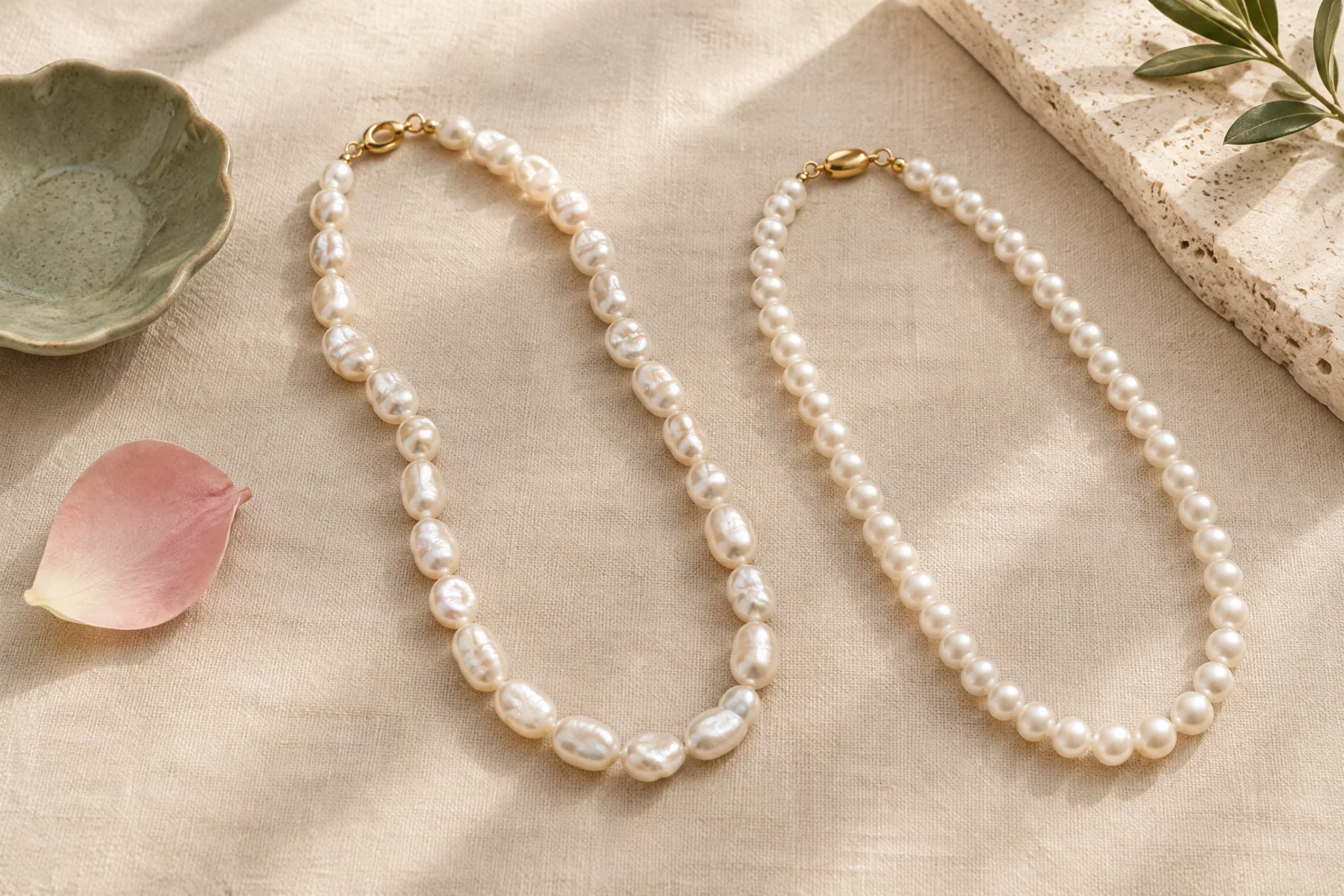
Look first at the visual rhythm. Freshwater pearls can vary from bead to bead in shape, surface character, size, and luster. A strand may feel softly organic rather than perfectly repeated. Those variations are part of the material’s character, not necessarily a flaw. Faux pearls are manufactured, so they can be made in closely matched sizes and silhouettes. That uniformity can create a clean, polished line—especially useful when you want a neat, graphic effect or a coordinated pair of earrings. Faux pearls can be a considered choice when this evenness is exactly the look you want.
Color deserves a closer look than “white.” Pearl color includes a body color and may show additional overtones; GIA notes a wide range of pearl colors, including white, cream, gray, silver, and hues with pink, green, purple, or blue overtones. Imitation finishes can also range from creamy and warm to cool white or softly iridescent. Compare jewelry in neutral daylight when possible, and hold it near the colors you wear most. A warm ivory can blend beautifully with cream knits and earthy neutrals; a cooler white may read crisp against navy, charcoal, or clear pastels.
Touch is not a reliable at-home authenticity test. Surface texture, temperature, weight, and shine can be suggestive, but treatments and construction vary, and a quick “tooth test” can scratch a surface or damage a piece. Do not rub pearls against teeth, scrape them, or use household chemicals to identify them. If an inherited or valuable strand needs identification, consult a qualified jeweler or gem professional rather than making a guess from one visual clue.
Think about the role the jewelry will play. A petite cultured pearl stud can bring a quiet point of light to a workday; a row of evenly matched faux pearls can make a more deliberate, dressy statement. For a playful, fashion-forward option, faux pearls also appear in larger motifs and colored designs. Consider how faux pearls will sit with your usual color palette before choosing a bold finish. Duddingtons’ Nova earrings, for example, are described in the catalog as gold-plated mixed metal with faux pearls in a 25 mm hoop design. That example illustrates one possible styling direction, not a claim that all imitation pearls share the same material or construction.
Consider comfort and construction as well as the pearl itself. A necklace’s clasp, stringing, length, and overall weight affect how it sits and feels. Earrings depend on the post or closure and the complete piece’s weight, not just the bead. If you are shopping for a gift, ask about material details and preferences rather than assuming that “real” is always preferred. Some people love natural variation; others want repeatable shape, a specific color, or a look that feels easy to wear with their existing wardrobe.
Read the listing before you choose
Product copy is most helpful when it names both the pearl type and the other components. Scan for “freshwater cultured pearl” or another clearly stated pearl category, and look for “faux,” “imitation,” or “simulated” when the pearls are manufactured. Then check whether the maker identifies the imitation’s base material or coating. If a description only says “pearl-look” or “pearl detail,” treat that as a style description, not a complete materials disclosure. For faux pearls, request the underlying material and finish if they are not named.
Next, read the whole jewelry recipe. A pair of earrings could combine faux pearls with gold-plated metal; a necklace could use cultured pearls with a silk or synthetic cord and a metal clasp. These combinations matter because the most delicate or care-sensitive component often determines how the whole piece should be handled. Avoid inferring solid gold, gold-fill, or a particular alloy from a gold-colored surface. Plating, fill, and solid gold are different material descriptions, and the listing should say which applies.
Use a short checklist when details are missing:
- Identity: Are the pearls freshwater cultured, another cultured type, natural, or imitation?
- Imitation materials: If they are faux pearls, does the listing state whether the core is glass, plastic, or something else, and how the surface is finished? With faux pearls, this information helps set realistic expectations.
- Other components: What are the metal, string, clasp, and earring findings made of?
- Scale: Are measurements or a clear size reference provided, and will the piece suit the neckline or ear styling you have in mind?
- Care: Is there guidance for the specific combination of materials?
Questions are useful, not fussy. Ask how a surface is described, whether a strand is knotted, or what the earring backing is made from if that affects your decision. A trustworthy answer should clarify what is known without turning an unknown into a promise. Be cautious about broad claims such as “won’t ever change” or “safe in every situation”; finishes, adhesives, and mixed materials can respond differently to wear.
For a wider comparison of styles, browse the Duddingtons earrings collection or necklaces collection, then use each item’s material notes rather than relying on category photography alone. Color and scale can look different on a screen, so zoom in on the details and compare stated measurements with jewelry you already own. A category page helps you explore silhouettes; the individual description is where material claims belong.
Care for each type without overpromising
Care should follow the material, not just the word “pearl.” Cultured pearls have a relatively soft surface. GIA advises avoiding scratches, high heat, acids, and common substances such as perfume, cosmetics, hairspray, and perspiration; it recommends wiping cultured pearls with a very soft, clean cloth after wear. Keep them separate from harder jewelry so metal edges and gemstones do not rub against them. Put pearl jewelry on after fragrance, hair products, and makeup have been applied, and remove it before activities that expose it to sweat, chemicals, or knocks.
For routine care, gently wipe a cultured pearl with a clean, soft cloth. Do not assume that a necklace containing pearls, cord, plated metal, or glued components can be soaked. GIA says warm, soapy water may be used for occasional thorough cleaning of pearls and that a strung item should be fully dry before wearing; a mixed-material piece may have additional sensitivities. If its construction or maker’s care directions are unclear, use a dry cloth and ask a jeweler or seller before introducing moisture. Avoid ultrasonic and steam cleaners for pearls.
Faux pearls do not have nacre, but their manufactured coating may still be vulnerable to abrasion, solvents, heat, or moisture, depending on its material and construction. There is no single cleaning recipe for every faux pearl. Because faux pearls can have different coatings and cores, care instructions should be specific to the piece. A conservative starting point is to wipe the surface with a soft, dry cloth after wear, keep the piece away from sprays and rough contact, and store it in a separate pouch or compartment. Follow any care instructions supplied for that specific piece; do not soak it simply because the pearls are imitation.
Store both kinds out of direct heat and away from sharp objects, ideally in a soft-lined space where necklaces are not tangled and earrings are not pressed against harder pieces. Avoid sealed, damp storage and avoid leaving jewelry on a sunny windowsill or in a hot car. Before putting a strand away, check the clasp and string for visible wear. If a cultured pearl strand is loose or damaged, stop wearing it until a jeweler can assess it. With faux pearls, pay attention to chips, peeling, or a change in the surface finish; gentle handling can help limit further friction, but it cannot restore a worn coating.
Ultimately, choose the piece whose appearance and stated materials fit your life. Freshwater cultured pearls bring the particular variation of a mollusk-grown gem; faux pearls bring a deliberately made interpretation that can be consistent, expressive, and easy to style. Neither description tells the whole story without the base materials, construction, and care notes. Faux pearls are most satisfying when their design and finish are chosen with those details in view. Read those details, choose the color that makes your wardrobe feel more like you, and treat each piece according to what it is actually made from.
Related reading
For more material context, continue with Gold-Plated vs Gold-Filled Jewelry: A Clear Comparison, Glass Beads vs Gemstone Beads: Color, Feel, and Care, and What Is Gold-Plated Stainless Steel Jewelry?.