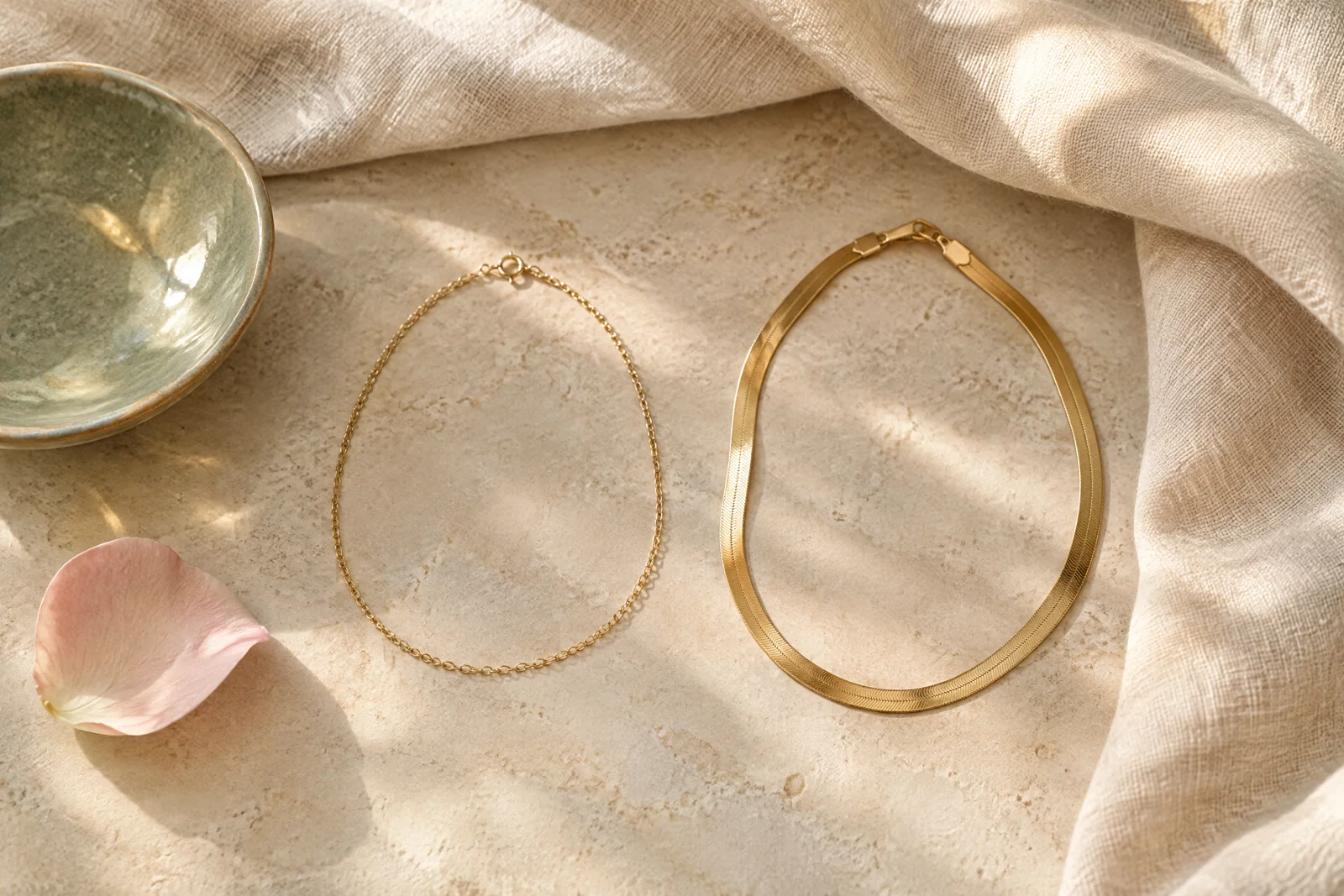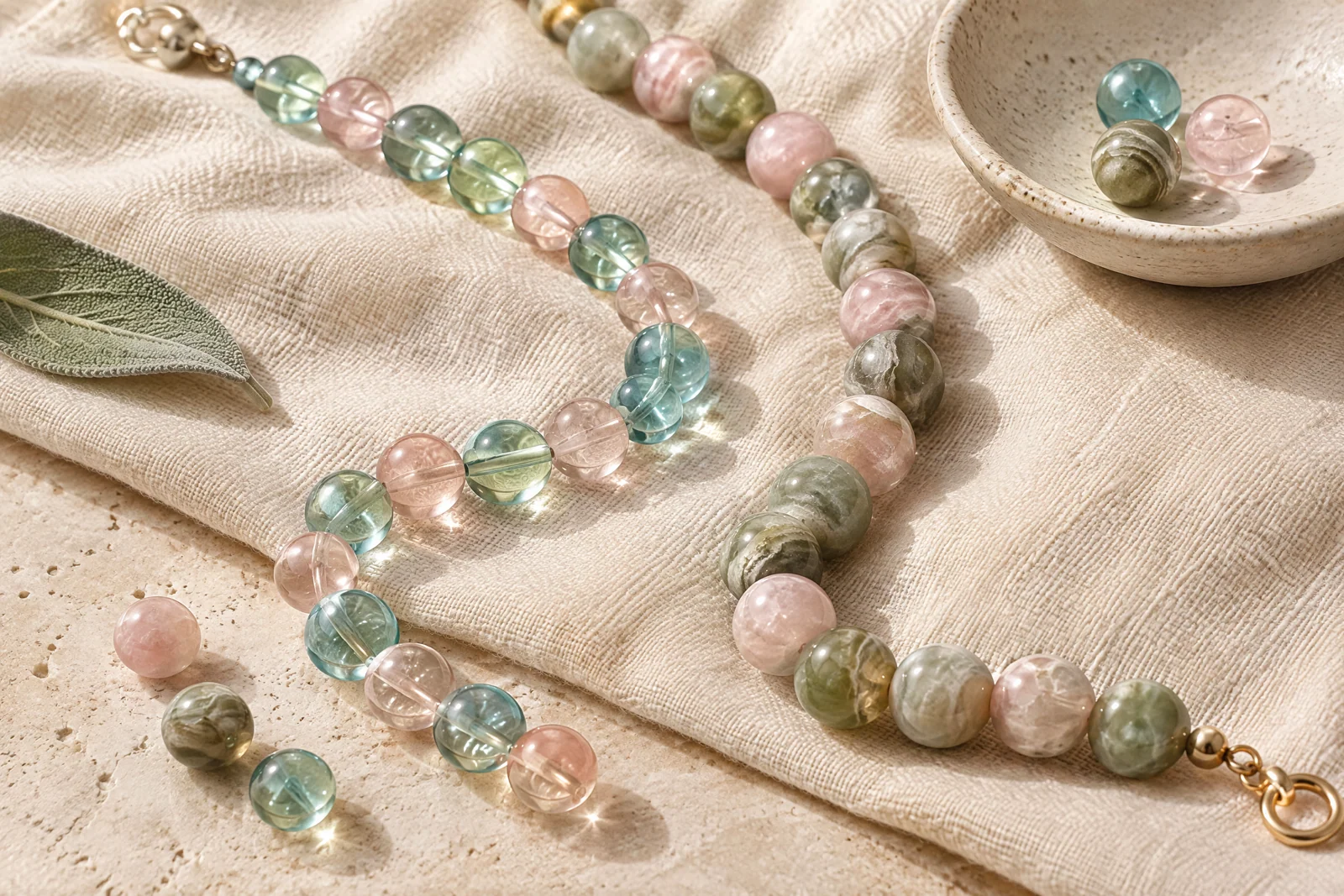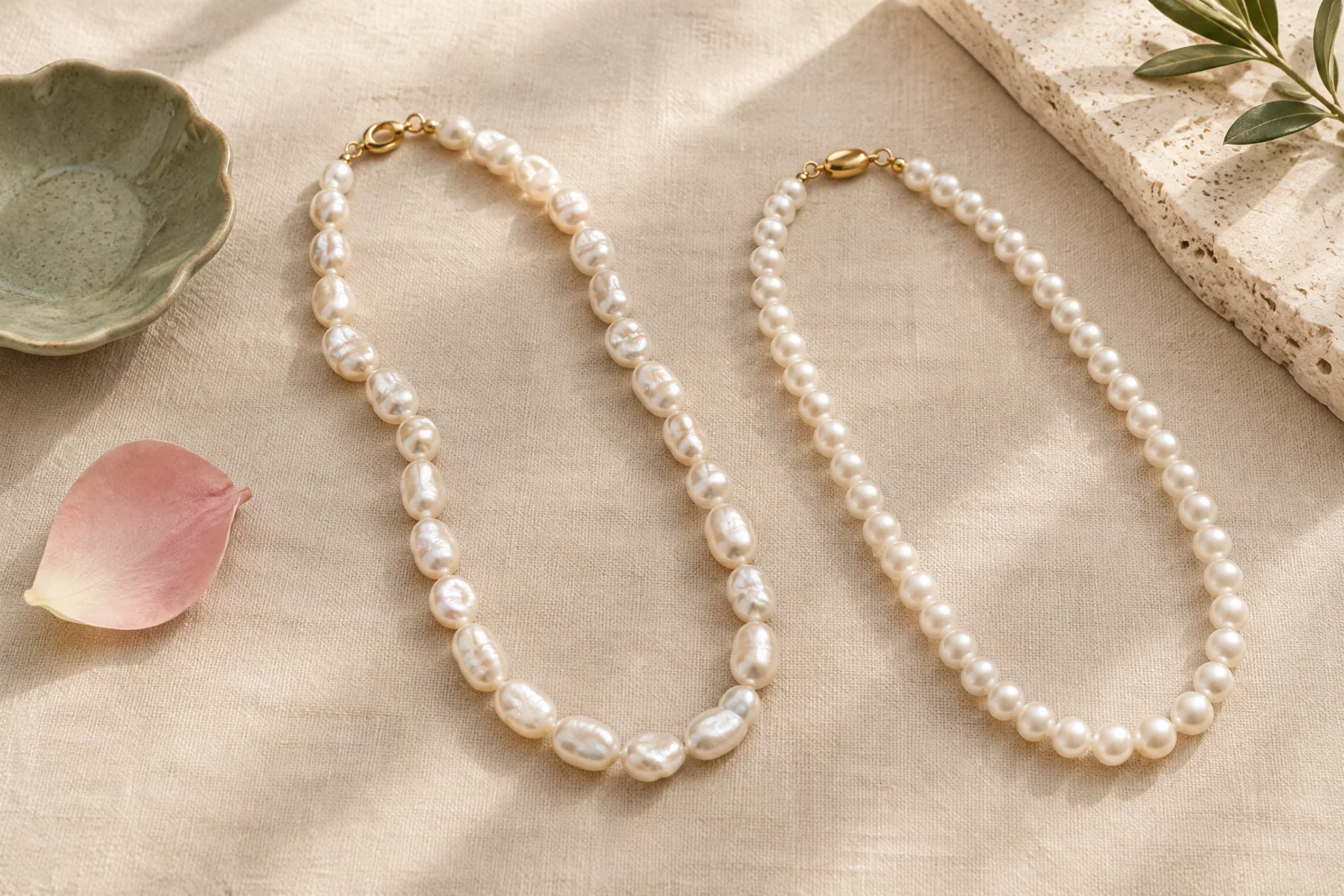
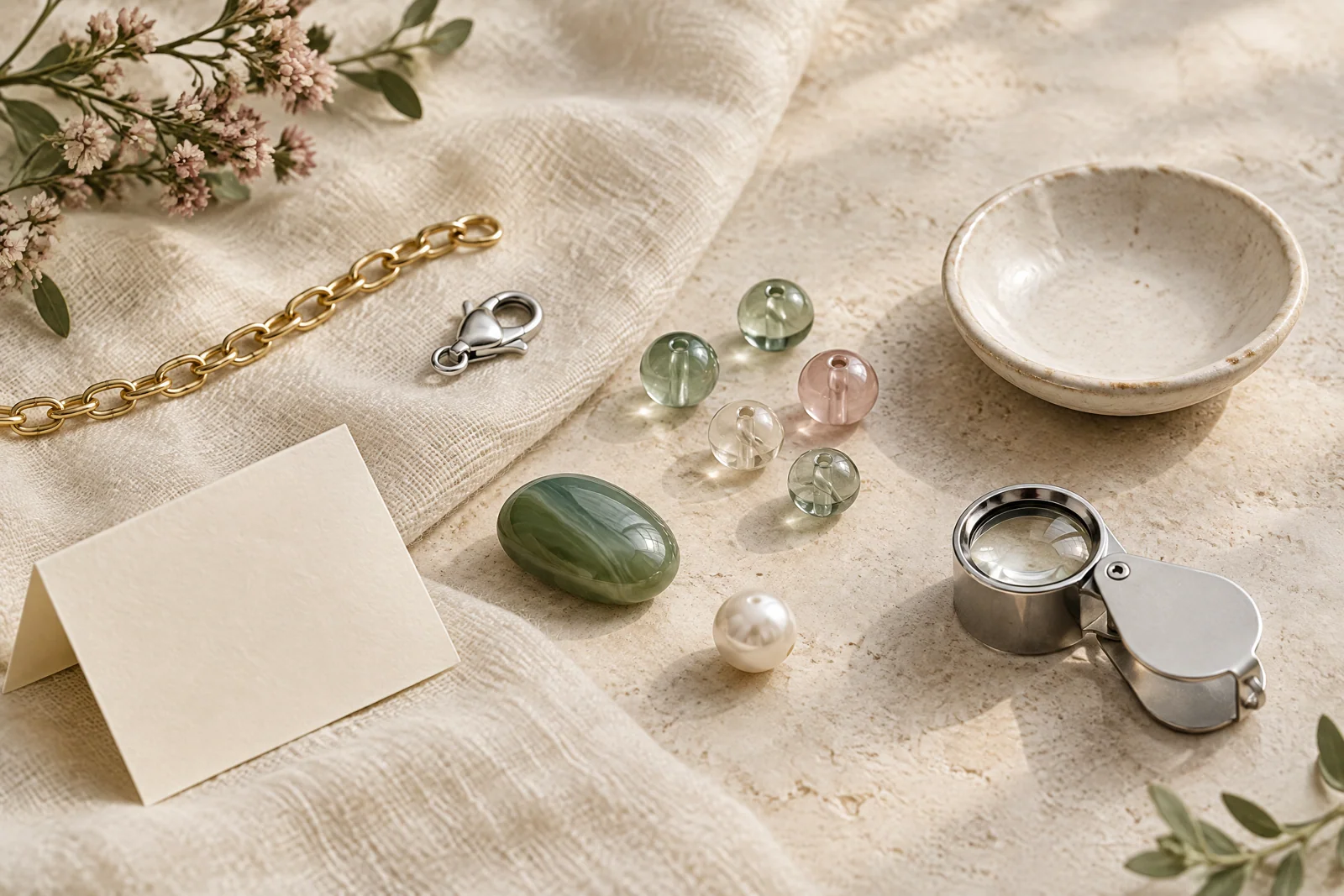
A piece can look golden, silver-toned, pearly, or stone-set in a product photo, but appearance alone does not tell you what it is made of. Reading jewelry materials means looking past the color name to the components, the finish, and how those parts come together. A short phrase such as ‘glass beads and gold-plated mixed metal’ can answer several practical questions—if you know how to parse it.
This guide offers a calm, useful way to read a listing before you buy: identify the main material, separate a metal’s base from its surface, note every component, and decide what information you still need. The goal is not to judge one material as universally better. A useful reading of jewelry materials keeps appearance and composition separate. It is to match a piece to your taste, habits, budget, and comfort with its care.
Start with the whole materials line, not the color
Begin by treating a material description as a small inventory. In ‘glass beads and gold-plated mixed metal,’ there are at least two categories: the beads, and the metal components with a stated surface finish. This is the first habit that makes jewelry materials easier to compare. The color ‘gold’ describes how the metal looks; it does not, by itself, tell you that every part is solid gold. Likewise, ‘silver’ in a color menu may mean a silver-colored finish rather than sterling silver.
Scan for nouns first: stainless steel, brass, sterling silver, glass, resin, acetate, agate, shell, freshwater pearl, faux pearl, cord, or leather. Then look for describing words that tell you about the finish or type: plated, gold-fill, polished, enamel-coated, imitation, or natural. The nouns identify the material category; modifiers refine what is claimed about it. That small distinction makes jewelry materials descriptions much more precise. If a description lists several materials joined by ‘and,’ assume each may belong to a different part of the design unless the listing explains otherwise.
That distinction is useful when browsing a broad jewelry collection or narrowing your search to necklaces. Ask yourself: What touches the skin? What forms the visible centerpiece? What makes up the chain, post, clasp, or connector? Thinking by component turns jewelry materials into practical information. A pendant and its chain can have different compositions; an earring can combine a metal fitting with a bead or shell. A material statement should be read piece by piece, not as a promise that the whole item shares one composition.
Descriptions vary in detail. Some name every component; others use broad wording such as ‘mixed metal.’ That phrase tells you more than a color alone, but less than a complete breakdown. If a particular part matters to you, look for its material in the description or ask the seller which metal is used for the post, hook, chain, clasp, or other part. Do not fill in a missing detail by guessing from a photograph. For jewelry materials, an unanswered question is still an unknown.
Separate the base metal from the surface finish
For metal jewelry, separate two questions: What is the underlying material, and what—if anything—is applied to its surface? Keeping those jewelry materials questions distinct prevents a color from becoming a composition claim. ‘Gold-plated stainless steel’ names a stainless-steel base with a gold-colored plated surface. ‘Silver-plated mixed metal’ signals a silver-colored surface on metal components, while the exact base metal is not specified. A listing that says ‘gold-tone’ may describe color without naming either the base or a plating process.
Gold descriptions deserve especially careful reading because ‘gold,’ ‘gold-plated,’ ‘gold-filled,’ and ‘solid gold’ are not interchangeable. The Federal Trade Commission’s consumer guide explains that karat marks describe the proportion of gold in a gold alloy, and that gold plating can wear over time depending on use and the plating’s thickness. The FTC also describes gold-filled and related terms as referring to a mechanically applied layer, which is distinct from a plated surface. This matters when comparing jewelry materials that use similar gold tones. For the wording and examples, see the FTC’s guide to buying gold, silver, and platinum jewelry and the current U.S. Jewelry Guides. A product’s own description still matters: do not treat a listing that mentions several finishes as if every component shared one.
Some products deliberately combine finishes or metals. For example, the catalog description for Mini Sun specifies an 18k gold-plated stainless-steel charm on a 14k gold-fill chain. The useful takeaway is not that the piece is all one kind of gold; it is that the charm and chain are described differently. Mixed jewelry materials can be intentional, but each part deserves its own reading. Similarly, the necklace Karia is described as glass beads with silver-plated mixed-metal details. Those component-level statements are more informative than an image caption that simply calls a piece gold or silver.
When a phrase is unfamiliar, do not rely on a number or adjective floating on its own. Ask what part it refers to, what the base metal is, and whether the named finish applies to the whole item or only selected components. A careful seller should be able to clarify a vague line. Clear answers help you understand jewelry materials without assuming more than the listing says. If the answer is still unclear, treat that uncertainty as part of the buying decision rather than silently assuming a premium material.
Read beads, stones, pearls, and mixed components literally
Nonmetal materials have their own vocabulary. Glass beads are made of glass; a gemstone description names a stone material; resin and acetate are distinct material names rather than synonyms for glass. Natural shell, freshwater pearls, and faux pearls are not the same category. The word ‘faux’ indicates an imitation, while ‘freshwater’ identifies a type of cultured pearl. Those distinctions make jewelry materials labels meaningful rather than decorative. If a listing says ‘pearl’ without explaining which kind, check the full description or ask before relying on a visual resemblance.
Also distinguish a material from a design treatment. Enamel is a colored finish or coating, not a substitute name for the metal beneath it. A bead may be glass, stone, or another material even if it has a glossy surface. ‘Gold-edged shell,’ for instance, may pair a shell component with a metal finish. These layers can affect appearance and handling differently, so one broad label rarely describes the entire object. Read jewelry materials as a set of components, not as one finish.
Look closely at the small joining parts, too. Clasps, jump rings, ear posts, hooks, extender chains, and bead caps may not use the same material as a pendant or bead. If a sensitivity or metal preference informs your choice, ask about the specific component that touches your skin; a broad product-level label may not answer that question. Your questions about jewelry materials can focus on one exact fitting. A seller’s response should be specific enough to identify the part, not simply repeat the product’s color.
Material details can also explain why two pieces with a similar palette feel different. Glass beads may give a necklace crisp color and a smooth, rounded look; an agate bead may show natural pattern variation; resin or acetate can create a bold, sculptural surface. Those are styling observations, not guarantees about weight or durability. Pair jewelry materials names with measurements for a clearer expectation. If size or feel matters, look for measurements and construction details as well as material names. The earrings collection, for example, may include designs where a small post, a larger decorative element, or a hinged fitting each has a different role.
“Mixed materials” is not automatically a flaw or a quality grade. Understanding jewelry materials is about fit, not ranking one recipe above another. It simply means you should understand the recipe. A beaded necklace might combine glass, thread, and plated metal findings; a charm necklace might pair a plated pendant with a separate chain material. For every component that affects comfort, appearance, or care, see whether the listing names it. If it does not, a quick question can save you from buying based on assumptions.
Turn the details into a confident buying decision
Once you can parse the description, use a short checklist. First, name the look you want: a warm gold color, cool silver tone, a vivid bead, or a natural pattern. Second, locate the base material and finish, rather than treating color as composition. That step keeps jewelry materials claims grounded in the actual wording. Third, check whether the item combines materials, and identify any component you care about most. Finally, look for the practical facts—length, dimensions, closure, and care instructions—that tell you how the jewelry will fit into your everyday routine. These details make jewelry materials easier to judge in context.
- What exactly is each component? Identify the chain or cord, centerpiece, findings, and finish.
- Which term is descriptive and which is a claim? Color words tell you about appearance; material terms should tell you what the item is made of.
- Is the base metal named? ‘Plated mixed metal’ does not specify a particular base alloy.
- Does the listing distinguish natural from imitation? Check words such as faux, imitation, shell, or freshwater.
- What care guidance fits this combination? Ask about the complete piece, not just one material in isolation.
Care is another reason to read the whole line. A necklace with plated metal, beads, and cord should not automatically be treated like a single-material chain. Mixed jewelry materials call for care advice that accounts for every element. Follow care instructions provided for that specific piece. When none are available, a cautious default is to keep jewelry away from household chemicals, cosmetics, and unnecessary moisture, then gently wipe and store it dry; do not soak a mixed-material piece or apply an ultrasonic cleaner unless the seller or a qualified professional confirms it is suitable for every component. Plated finishes can change with wear, and care cannot guarantee that a surface finish will remain unchanged indefinitely.
For an item you love but cannot fully decode, send a concise question before purchasing: ‘Could you confirm the base metal for the clasp and whether the finish is plated?’ Or: ‘Are these pearls freshwater or imitation, and what material is the chain?’ Clear answers help you compare like with like without turning shopping into a materials exam. A thoughtful approach to jewelry materials leaves room for personal style, too. If a detail is not supplied, it is reasonable to decide that the listing does not give you enough information yet.
At Duddingtons, our catalog descriptions use component details where provided; as with any online listing, read each item’s own wording rather than assuming one material applies across a collection. For help with a specific description, contact the boutique through our contact page. An informed choice is simply one that fits your eye and your expectations: know what the description does say, notice what it leaves open, and choose accordingly.
Related reading
Continue with our guides to gold-plated vs. gold-filled jewelry, glass beads vs. gemstone beads, and freshwater pearls vs. faux pearls.