Some statement earrings announce themselves with color; others win you over by being easy to wear for hours. Resin jewelry and acetate pieces often bring both qualities together: a substantial-looking silhouette with a lighter feel than many solid-metal designs. Their smooth surfaces can look glassy, softly cloudy, marbled, or nearly transparent, giving resin jewelry a fresh, dimensional presence.
The terms are related in the way shoppers encounter them, but they are not interchangeable material labels. Resin is a broad name used for many molded polymers, while acetate usually refers to a specific plastic material; in jewelry and accessories, descriptions may identify cellulose acetate. A useful resin jewelry listing should name the material rather than relying on appearance alone. Understanding that distinction helps you choose by finish, scale, and care—not by an assumption that every glossy piece is the same.
Here is a practical guide to what makes these materials appealing, how to style their color and shape, and what to look for before you buy. Think of resin jewelry as a way to add visual presence without automatically adding visual heaviness: the best choice is the one that feels right on your body and works with the clothes you already reach for.
Resin and acetate: similar look, different descriptions
Resin is an umbrella term, not a single recipe. In jewelry listings it often describes a molded material shaped into hoops, drops, beads, or decorative components. It may be transparent, tinted, opaque, or layered with color. The word alone does not tell you the exact polymer, how an item was made, or what other components it contains, so compare resin jewelry listings by their full material descriptions.
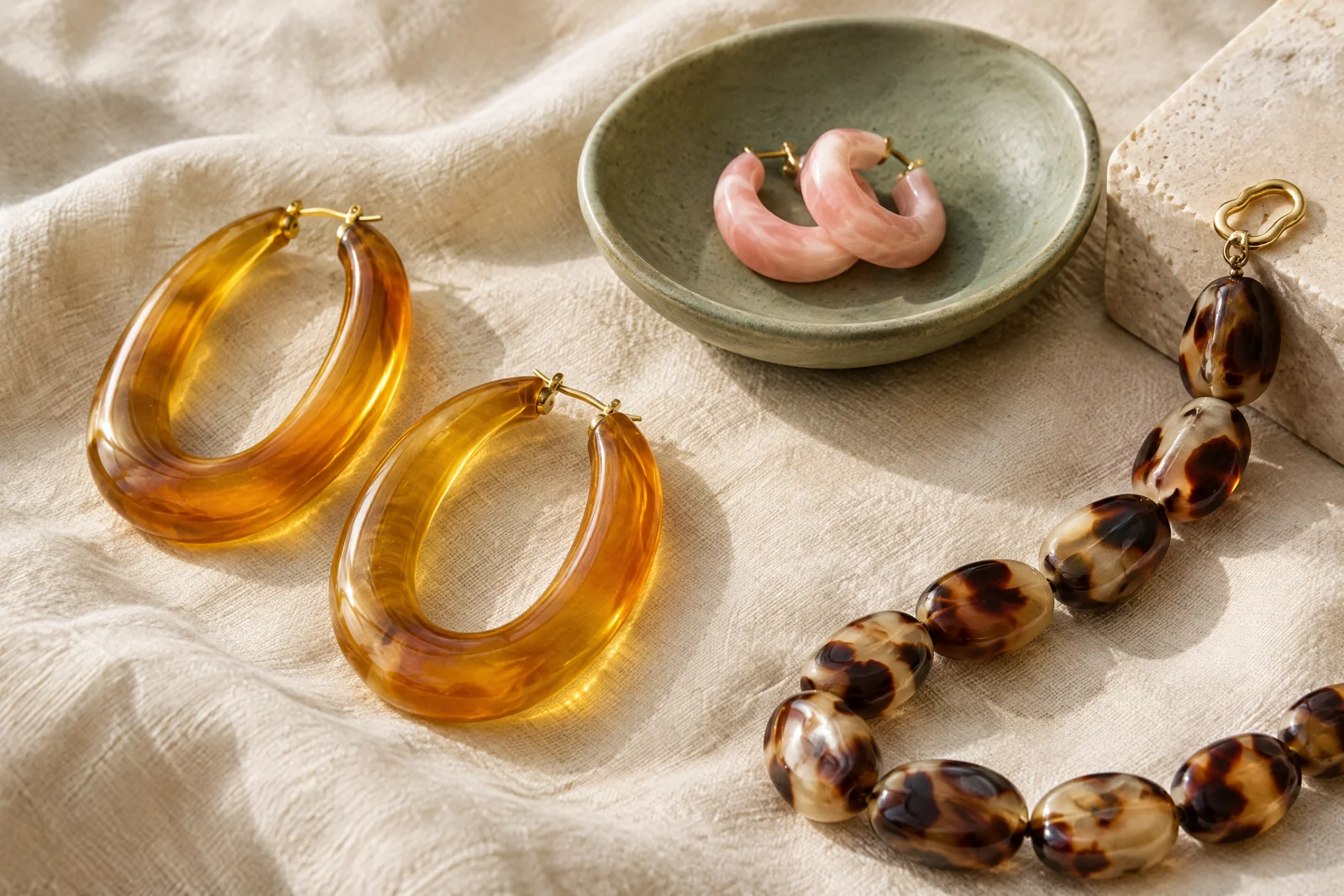
Acetate names a more specific material. Cellulose acetate is used in accessories and can be made in saturated, translucent, or patterned colors. Its distinctive appeal is often its depth: a tortoiseshell-like pattern, for instance, can shift from honey to dark brown instead of reading as a flat print. But do not assume that every marbled or glossy item is acetate. Check the product description for the stated material; looks alone cannot reliably identify whether a piece is resin jewelry or acetate.
In both cases, the finished jewelry may combine a nonmetal component with metal findings, posts, clasps, or plating. Those parts have different care needs, so a resin jewelry piece may need a gentler approach than its metal fittings. A resin hoop with a metal fitting is not simply “plastic,” and an acetate bead necklace may include plated hardware. If you have sensitivities or specific wear requirements, review the exact component list and ask the retailer about anything the listing leaves unclear; do not infer comfort or skin compatibility from the material name alone.
Weight is also individual. These materials are often chosen for statement shapes that would feel different if made entirely in metal, but dimensions, thickness, hardware, and construction all affect how a piece wears. A broad, thick hoop can feel more substantial than a slim drop, even when both are made from resin. For resin jewelry, product measurements are useful, but they do not replace trying an item when comfort is your deciding factor.
For a real example of the distinction, Misty is described as clear resin earrings with gold-plated mixed-metal details and a hinged ear fitting; the listing gives an overall width of 30 mm. Fenella is a coral-colored necklace made with acetate beads and gold-plated mixed metal, with an approximate 42 cm length plus extender. These examples show how material, hardware, color, and scale work together. Browse the earrings collection or necklaces collection for silhouettes that suit your own preferences.
How to choose a color, finish, and scale
When styling resin jewelry, start with the colors already in your wardrobe rather than treating a bright piece as a special-occasion-only purchase. A warm amber or tortoiseshell pattern sits naturally beside cream, camel, denim, and deep brown. Clear or softly tinted resin can add shine while letting a patterned blouse remain the focus. Coral and blush enliven white, navy, sage, and warm neutrals. These are styling suggestions, not rules: undertone, lighting, and the exact shade can change the effect.
Look at contrast as well as color. A transparent piece has a lighter visual outline than an opaque one, even if its silhouette is large. Patterned acetate can act almost like a print, so it may pair beautifully with solid clothing or echo one color in a stripe or floral; resin jewelry can be the outfit’s color note. For a quieter outfit, repeat just one small note—the warm brown in a tortoiseshell bead, for example—in a belt, shoe, or bag. You do not need a perfectly matched set.
Scale helps determine whether a piece feels like an accent or the focal point. With bold resin jewelry, pick one main shape first: a wide hoop, a chunky bead strand, or a sculptural pendant. Let the rest of the outfit provide breathing room, especially when resin jewelry is the focal point. If you want to layer, vary the visual weight: pair a simple short necklace with a longer fine chain, or keep earrings small when a patterned necklace already draws the eye.
Consider neckline and movement. Hoops and drops frame the face and can be especially visible with hair tucked back; a beaded strand sits close to the collarbone and works well with an open collar or crew neck. A smooth, rounded shape can soften crisp tailoring, while an angular silhouette may add definition to a flowing top. When choosing earrings, remember that resin jewelry should be judged by its movement as well as its front view, and check the closure style in the listing.
One easy outfit formula is a single saturated accessory against a neutral base: amber-toned hoops with an ivory shirt, or a coral bead necklace over a navy knit. For a more playful combination, use two colors that already appear together in your clothes, then keep metal accents consistent—or mix them deliberately with another piece you love. You can explore complementary shapes in accessories without making every element compete for attention.
Above all, let comfort set the scale. If you tend to prefer discreet jewelry, choose a smaller resin drop or translucent finish instead of forcing yourself into an oversized silhouette. If bold color is already part of your style, a larger shape can feel surprisingly versatile when its palette connects with several outfits. Lightweight-looking is not a guarantee of lightweight-feeling, so use measurements and construction details as your guide.
Care for resin and acetate with a light touch
Because pieces may combine different materials, follow the care directions supplied with the specific item whenever available. As a cautious everyday habit, take jewelry off before applying fragrance, hair products, sunscreen, or lotion; let those products settle before putting it back on. Wipe the nonmetal surfaces gently with a soft, dry cloth after wear, and avoid abrasive pads that could mark a polished finish.
Do not soak mixed-material jewelry as a general cleaning shortcut. Water can reach joins, settings, cords, or metal components, and the item’s construction matters as much as the main material. Avoid household cleaners, alcohol, acetone, and other solvents unless the maker explicitly approves them for that exact piece. A solvent that seems harmless on one component may affect another or change the finish.
Heat and prolonged direct sun are also best avoided as storage conditions. Keep pieces away from hot windowsills, radiators, and a parked car; store them in a dry place where they are not pressed under heavier accessories. Separate compartments or a soft pouch help prevent scratches and tangles. Fasten chains before putting them away, and avoid stacking hard-edged pieces directly against polished resin or acetate surfaces.
For a mark on resin jewelry that will not lift with a dry cloth, pause before trying a stronger cleaner. Check the care information or ask the retailer for material-specific guidance, especially when a piece includes plated metal, a painted or patterned surface, or a moving fitting. Gentle care is not a promise that a piece is scratch-proof or will retain a particular finish forever; it simply reduces avoidable wear in ordinary handling.
When traveling, pack each piece separately and keep it out of direct sun and heat. A small pouch inside a larger bag can stop accessories from knocking together, but do not overfill it with hard objects. When you arrive, inspect clasps and earring fittings before wearing them. These small habits help preserve the finish and keep your favorite resin jewelry ready to style again.
A confident way to wear color every day
Resin and acetate invite experimentation because color and shape can do the expressive work without requiring a complicated outfit. Begin with a piece that repeats a shade you already enjoy, then try it with a plain top, a familiar dress, or denim. Notice whether you prefer transparency, a marbled pattern, or a solid color; those differences matter more than chasing a trend or choosing the biggest silhouette.
Before purchasing, look for a clear material description, dimensions, closure information, and details about metal components. Ask a question if a listing does not answer something important to you. The words “resin” and “acetate” describe useful starting points, not every detail of construction or fit. Reading those specifics makes it easier to compare pieces and choose one you will actually reach for.
At Duddingtons, our edit is guided by color, character, and the pleasure of wearing a distinctive detail in an everyday way. A clear hoop can add a bright note to a simple outfit; a patterned bead can bring warmth to a crisp shirt. A resin jewelry piece in a color you love can become a dependable finishing touch. Let your own comfort and palette make the final call, and wear resin jewelry in a way that feels like you.
Related reading
For more on materials and styling, continue with Gold-Plated vs Gold-Filled Jewelry: A Clear Comparison, Glass Beads vs Gemstone Beads: Color, Feel, and Care, and Freshwater Pearls vs Faux Pearls: What to Know.