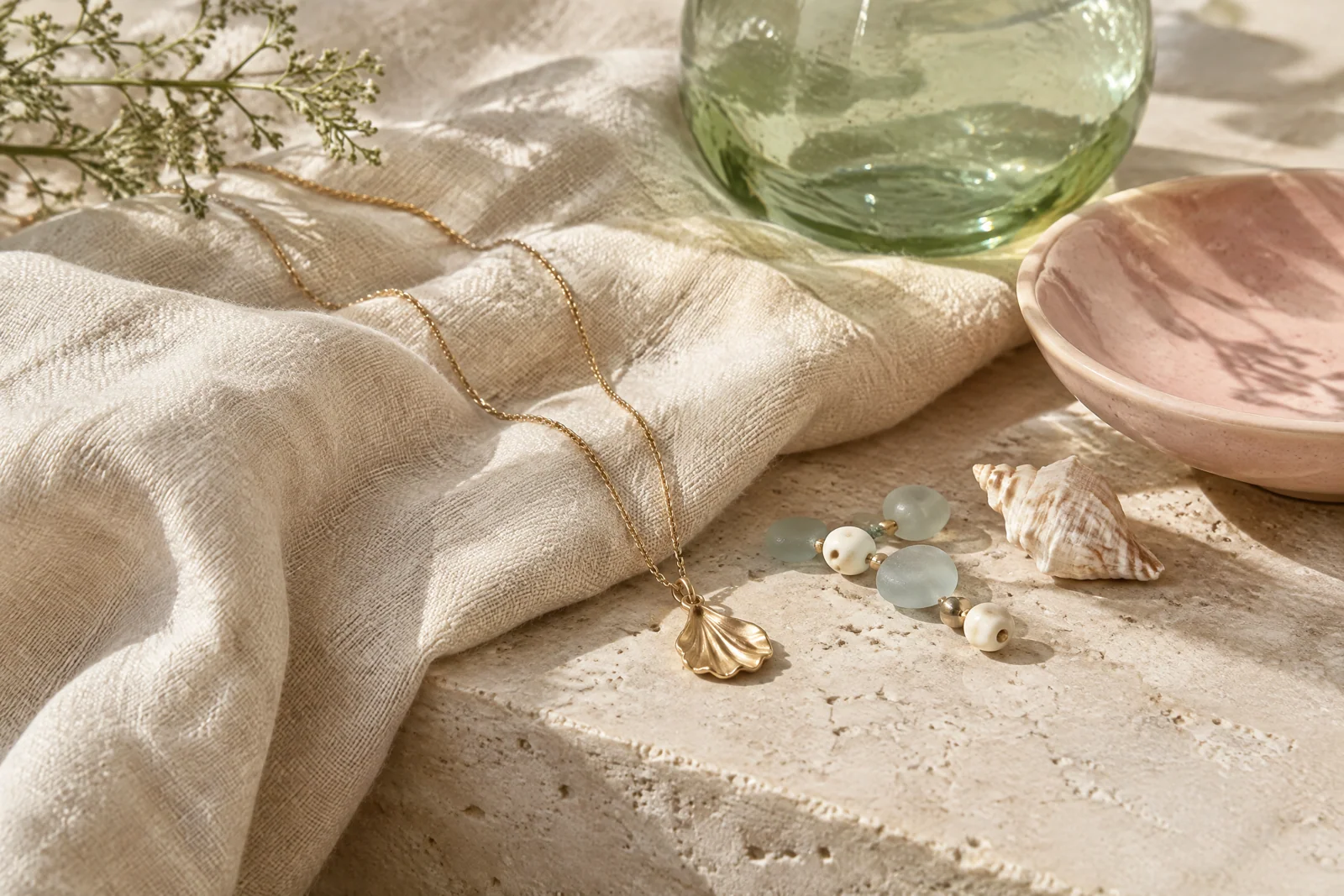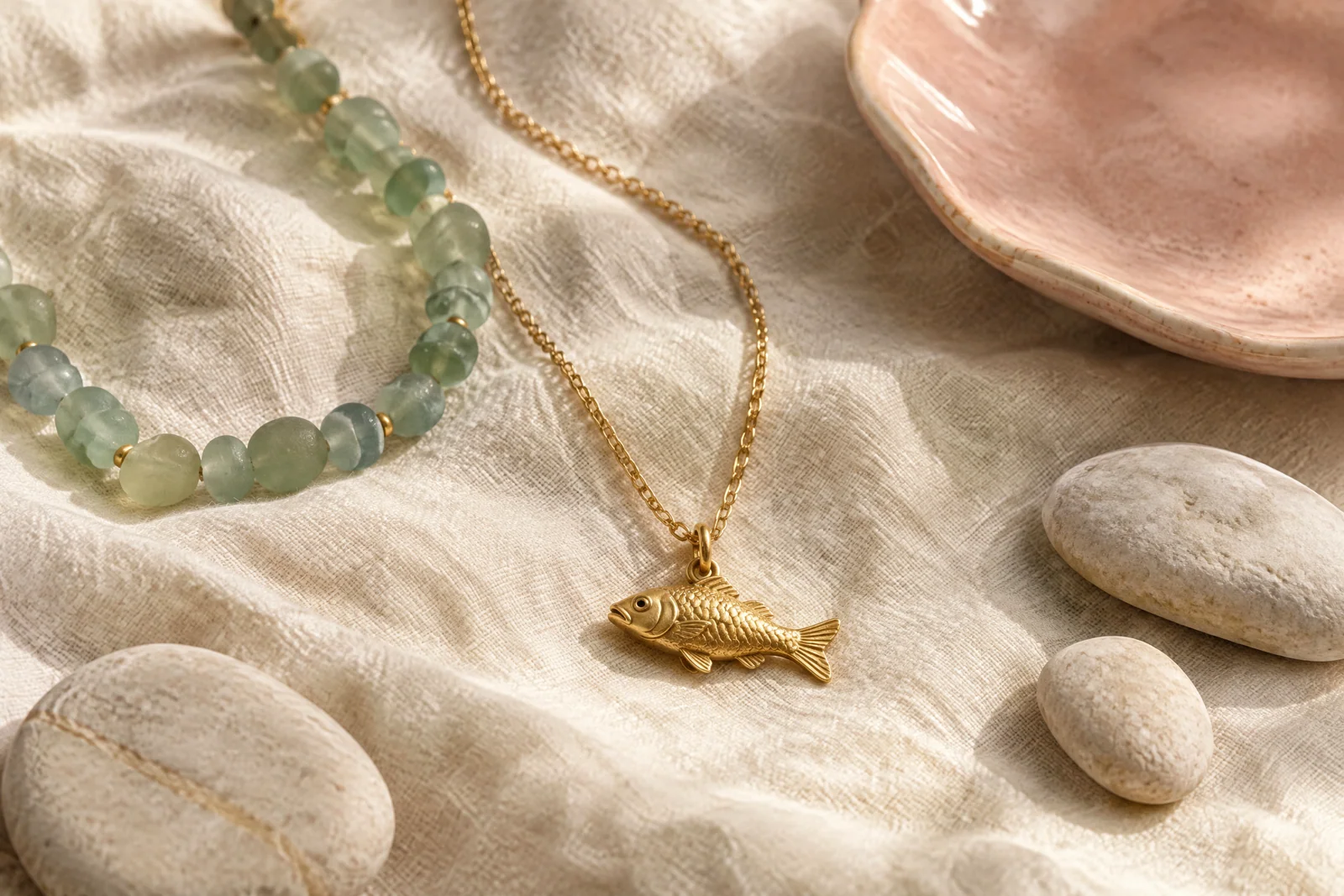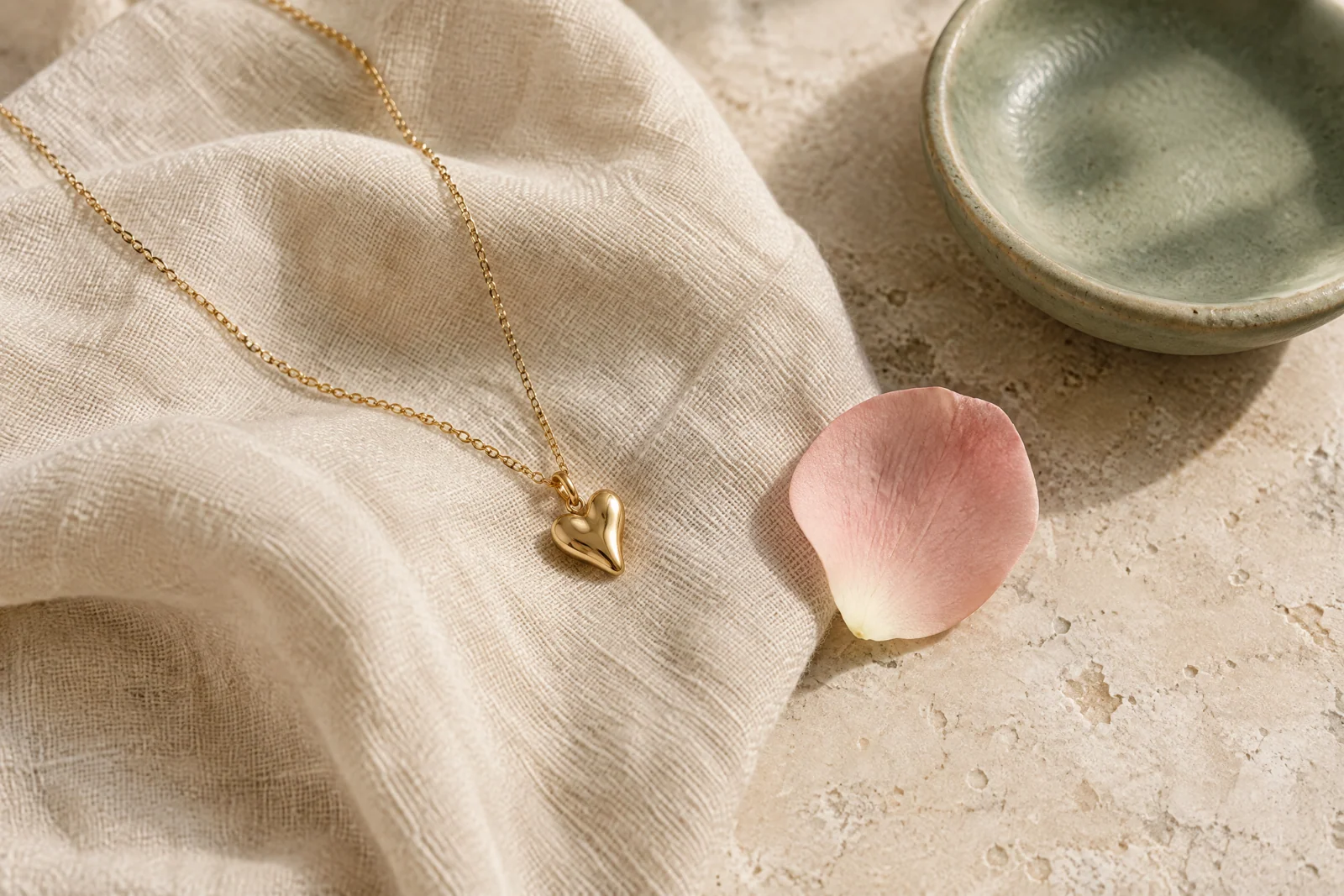
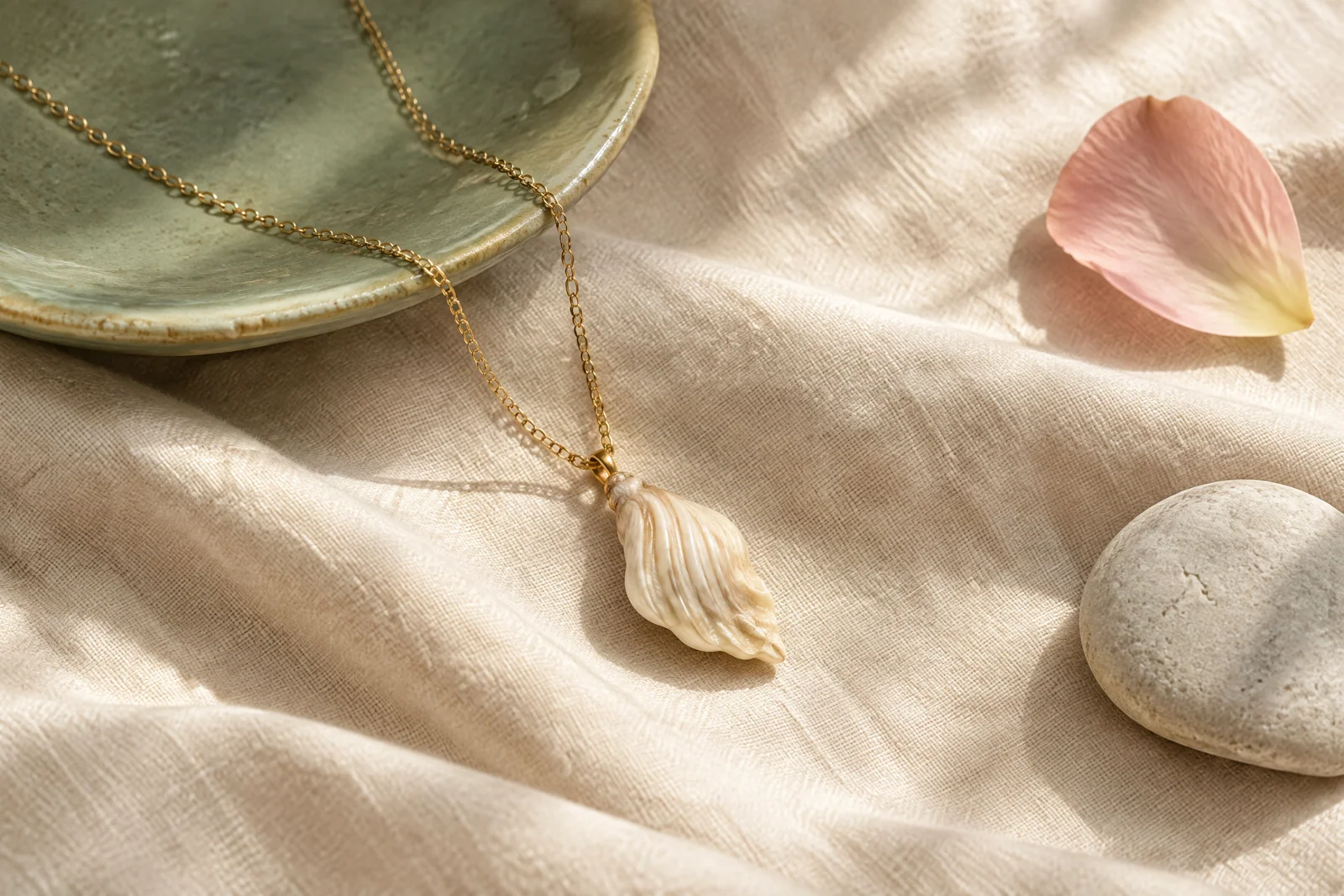
Shell jewelry has a way of carrying a little light with it: a soft sheen, a curved silhouette, or a warm ivory tone that feels relaxed rather than formal. The key to wearing it beyond a seaside escape is to treat it as a design detail, not a costume cue. A shell can be subtle against a white shirt, graphic with a dark knit, or playful beside saturated color. Because natural shells vary in markings, shape, and tone, each piece brings its own visual character. This guide to shell jewelry explains how to choose that character, balance it with an outfit, and care for mixed-material designs with a light touch.
Read the shell’s shape, surface, and natural variation
Before deciding what to wear with shell jewelry, take a moment to notice what the shell itself is doing. A smooth, rounded shell reads differently from a ridged scallop; a small pale charm feels quieter than a broad pendant. Texture matters too. A softly lustrous surface catches light gently, while a more sculptural outline creates a crisp focal point even when the color is understated. These qualities are useful style clues: the more pronounced the shape, the less competition it usually needs from other accessories.
Natural variation is part of the appeal, and also a reason to look carefully at product photographs and descriptions. Shells may differ slightly in markings, size, or tone, so a piece should be understood as an individual object rather than a perfectly uniform component. Duddingtons’ Sunday Sun necklace, for example, is described as a shell decorated with gold stripes on a gold-plated silver box chain; the shells are listed as ranging from 17 to 25 millimeters. That small range can change the balance on the body, while the gold detailing gives the pale shell a defined edge.
Think about the mood you want the piece to set. A single shell pendant can feel minimal when the chain is fine and the rest of the look is clean. A shell paired with bright enamel, colored beads, or a glossy cord feels more playful. A group of shell elements creates a stronger, more textured statement. None is inherently more polished than another; the choice is about how much visual attention you want the jewelry to hold.
It also helps to distinguish a shell motif from a natural shell component. Some jewelry uses real shell, while other designs borrow the outline or color in metal, glass, or another material. Read the item description for the materials named rather than assuming from appearance alone. For example, the catalog describes the On The Beach earrings as real shells edged with silver, set with blue-enamel-coated gold-plated hoops. Their blue accent brings a cool note, and the shell markings are described as unique. Knowing those details helps you imagine both the color story and the particular character of the pair.
Choose scale and color that feel like you
Scale is one of the quickest ways to make shell jewelry feel considered. A petite charm leaves room for other details and works naturally with a collar, open neckline, or fine chain. A larger pendant asks for space: try it over a plain top, on a simple cord, or against an uncluttered neckline where its silhouette can be seen. Earrings follow the same principle. Small shell drops add a glint; larger shapes become the main event, so keep the rest of the look calm if you want an easy balance.
Use the neckline as a practical guide. A short necklace can sit neatly with a crew neck or open shirt; a longer cord creates a vertical line over a high neckline. Check listed lengths and pendant dimensions before choosing. For shell jewelry, proportion matters more than a styled photograph. Browse the necklace collection to compare chain, cord, and pendant shapes.
Color takes shell jewelry beyond familiar beach whites and blues. Cream and honey sit easily with warm neutrals, denim, olive, and blush; gold edges can echo buttons or a belt buckle. Cooler shells and blue details sharpen white or charcoal. If a piece has a strong accent, repeat that color once elsewhere, then let the jewelry remain distinctive.
For a relaxed mix, set one shell piece beside a contrasting texture rather than another coastal motif. A smooth pendant works with linen, cotton, or fine knit. Vary bead scale when layering, and give necklaces different lengths so they do not merge into one dense band. Gold and silver can mix when one element connects them; let one piece lead. Shell jewelry needs room to read; a restrained mix lets its texture stay visible.
Our earrings collection offers another way to bring shell into an outfit without adding a necklace to a busy neckline. Shell jewelry in earrings keeps the neckline free and frames the face. Pair shell earrings with a simple chain or bare neckline; if the earrings are colorful or textured, keep other jewelry smaller. Conversely, if the shell detail is tiny, a colored necklace or stack of slim bracelets can add interest without competing. Think in terms of proportion around the face and neck, not rigid rules about matching sets.
Make coastal details work in everyday outfits
To wear shell jewelry on an ordinary day, start with familiar clothes. A white shirt and denim give a pendant a clean backdrop; black makes a pale shell graphic. Stripes can work with a simple piece, but avoid piling several busy patterns together. The result keeps a coastal note while feeling grounded.
Try shell jewelry with tan, rust, coral, blush, sage, or navy, depending on the shell’s tone. Gold edging can warm green; ivory stands out against navy. These are options, not rules—choose colors you enjoy and make sure the jewelry remains visible against the outfit.
Layering works best when each piece has a distinct job. Use one shell necklace as the focal point, then add a finer chain with a different length or a simpler profile. If both necklaces have prominent pendants, let them sit far enough apart to read separately or choose only one. A long cord necklace may be worn at different lengths if its design allows; the Duddingtons Scallop Shell necklace is described with a one-meter fabric cord that can be wrapped as a choker or worn long. Treat this as a styling example and check how a cord is intended to be fastened before experimenting with a new configuration.
Shell jewelry can be a finishing note rather than a centerpiece. Try shell hoops with a blazer or a pendant with a knit and tailored trousers. For dinner, leave the neckline clear and add another accessory only if it brings a distinct detail. On weekends, let a bright or irregular shell supply the personality; the goal is everyday ease, not dressing for a destination.
Choose jewelry by where you want the accent: necklaces sit with the neckline, earrings frame the face, and bracelets catch the eye in motion. If a collar is already prominent, earrings may be simpler; if you prefer bare ears, a pendant can add interest. The best shell jewelry is the piece you can imagine wearing repeatedly, not only on vacation.
Care for mixed materials with a gentle routine
Shell jewelry often combines shell or shell-shaped elements with chain, plated metal, enamel, cord, or beads. Since materials can respond differently to moisture and cleaners, follow item-specific instructions. If none are supplied, remove it before bathing, swimming, exercise, or cosmetics, and do not soak a mixed-material piece.
After wearing, gently wipe the piece with a soft, dry cloth, taking care around the shell, joins, and plated finish. Avoid abrasive cleaners, chemicals, and ultrasonic cleaning on mixed materials. If residue remains, pause and ask the retailer for material-specific advice rather than testing a liquid cleaner.
Let jewelry dry before storage, keep it separate from pieces that may scratch or snag, and avoid tangled chains. A soft pouch or divided box protects a shell detail; store cords loosely rather than pulled tight. The aim is simply to reduce friction.
When shopping, check materials, dimensions, chain or cord length, and notes about natural variation. “Shell,” “mother of pearl,” and a shell-like metal motif are not interchangeable; a gold-colored surface alone does not identify its construction. Ask if a detail is unclear, and expect some individuality in natural shell markings and size.
Ultimately, shell jewelry is versatile when it feels like part of your wardrobe. Choose a scale you enjoy, connect its colors to clothes you own, and treat natural irregularity as character. One quiet pendant or a playful shell accent can work in warm weather and with cooler-season layers. Let shell jewelry remain a personal detail rather than a theme.
Related reading
Explore more coastal-inspired styling in Coastal Jewelry: Bringing a Little Seaside into Your Style, discover a playful motif in Fish Necklaces: A Playful Motif with Everyday Appeal, and find a softer symbolic accent in Heart Jewelry Beyond Valentines Day.